The Red Kite Trail

  • Date walked: 23rd January 2021
  • OS Map: Explorer 307 – Consett & Derwent Reservoir/Explorer 316 – Newcastle upon Tyne
  • Start/finish point: NZ 185 608
  • Distance: 21.73km
  • Elevation gain: 296m

With January being all about staying local, revisiting the paths I’ve walked many times and trying to see them through new eyes, I was beginning to think I’d explored pretty much everything there is to see around Gateshead. Granted there are always occasional rights of way you spot when poring over the OS map, and can’t quite remember if you’ve trodden them or not, but in terms of longer, more ‘interesting’ walks, I was perhaps getting tired. Thank goodness for Viewranger, then. In ‘Outdoors Map’ mode, I’ve noticed that all manner of labelled paths and longer distance walks are shown, some of which don’t appear on the OS map – other than as various green lines. So, we’re au fait with the Tanfield Railway path, we’ve walked the Bowes Railway path a dozen times, we’ve done the large and impressive loop that is the Tyne & Wear Heritage Way – 128km of local underfoot goodness – in both directions. Then there’s the Red Kite Trail.

The what?

Yes, the Red Kite Trail. Perhaps I missed the memo, perhaps everyone has walked it a million times, perhaps I’ve just been blind to the way markers. In my defence, though I’ve lived in Gateshead for eight years, I’ve been walking for only a quarter of that time. Perhaps I’m still young, fresh, and ignorant. Well, certainly not young. Whatever the case, the Red Kite Trail is a delicious circular walk of about 20km taking in a stretch of the popular Derwent Walk, a tantalisingly short foray into the ever more popular Chopwell Wood, before heading up onto some high level (for Gateshead) farmland above Rowlands Gill, eventually dropping back down to your starting point at Winlaton Mill. Of course this is well known for being red kite territory – some 94 of these majestic birds of prey were reintroduced to the Derwent Valley between 2004 and 2009, and they seem to thrive. Many’s the time I’ve glanced up from my map on hearing the kite’s distinctive call, and watched one or two birds glide just above the treetops. They have their own walk, and I decided to explore for myself.

The Red Kite Trail

The walk starts at the wonderfully named Land of Oak & Iron, a local heritage centre with a substantial car park. The centre was, of course, closed due to a certain lockdown, but the car park was open, free, and not gated. This spot is well served by public transport, too: Go North East have all the answers.

This was one of those mild but frosty mornings we’ve had so many of lately, a little crunchy underfoot and the sun shining brightly most of the (short) day. A plethora of way markers served only to make me feel even more ignorant, and took me through a section of the Derwent Walk Country Park, around Kite Hill (the clues really have been there the whole time) and then soon up onto the Derwent Walk itself. This old railway, repurposed as a multi-use path between Swalwell and Consett, is a path I’ve walked many times, and makes for an easy and at times scenic (especially at the viaducts) plod. Number of red kites seen so far: none.

The Red Kite Trail

The Derwent Walk comes to a halt at Rowlands Gill to make way for a road, which must be crossed, but then I was soon back on the path and wandered another couple of kilometres until finally leaving the railway path above Lintzford. Just the A694 to cross now, then the rest of the walk would be all tracks and paths, or else very minor roads free of traffic. A word of caution – emerging at the pretty hamlet of Lintzford onto the road, I missed any way markers that may have been there, and for some reason followed what felt like the natural course of the path to the left, expecting to cross the road further up and head into the obvious woodland. Turns out a few other people made the same mistake (note the spur on the map above!), and after bothering to check the OS map, we found ourselves wandering awkwardly back down to the actual path – directly over the road from the bridge at Lintzford. An all-the-gear-and-no-idea moment, if you like. Anyway, once over the road I was greeted by a gate, a sign, and a path into Chopwell Wood. Number of red kites seen so far: none.

The Red Kite Trail

Chopwell Wood is a delight. 360 hectares of mixed woodland, with plenty of paths and enough ascent to remind you of more dramatic woods further north in Northumberland, it’s a popular spot for walkers, bikers, and apparently, red kites. The Red Kite Trail touches only the eastern edge of the woodland, the track rising steeply at first before levelling out and offering one or two very good viewpoints over the treetops. Atop one such viewpoint sits a wooden sculpture of a red kite – would this be the only red kite I’d see today? Pausing to enjoy the woodland views, and a sandwich, I did hear the mildly aggressive call of several jays, and caught the odd glimpse of light purple plumage in the trees. Number of red kites seen so far: none, unless you count the wooden one.

The Red Kite Trail
The Red Kite Trail

Onwards. Emerging from the woods, and after a short section of walking on a very quiet road, I arrived at Spen Banks. This smaller area of woodland was largely deserted – once out of the popular Derwent valley, it seems only dog walkers bother to explore here. I got the same kind of feeling I get whenever I watch the hordes ascending Helvellyn from my little vantage point at Stang End. I started thinking of the Lake District – something I keep doing during lockdown, and something I have decided is not healthy. Will we ever get to see lakeland again? My mind returned to the muddy path in front of me, and I kept my eyes and ears open for red kites. Soon the Red Kite Trail merged with the Tyne & Wear Heritage Way, so I was walking familiar territory. Then a little detour. Taking the track north, the RK trail heads up to the little village of Barlow, which at about 170m makes for a surprisingly good viewpoint north. This is the edge of kite territory, and after first questioning the detour, I acknowledged NZ 152 606 would be a perfect spot to linger, hopefully. Number of red kites seen so far: none.

The Red Kite Trail

After the Barlow detour, I followed the way markers back down to meet the heritage way once again, and the two trails became one for the rest of today’s walk. This is all farmland walking, with pleasant views south towards the Derwent Valley. Thornley Bank, High Thornley, Low Thornley, you mark your descent as much with etymology as you do with contours. The light was fading now, but still way markers appeared now and then, seemingly to remind me that I must have been blind not to have seen the RK trail when plodding these paths previously. Number of red kites seen: none.

The Red Kite Trail

The home straight. Once over the A694, the path snakes high above the river Derwent, along Winlaton Scar. I can vouch for one or two quite stunning viewpoints looking through the trees across to Gibside and the Liberty Monument, but by now it was dark and it was much more about negotiating patches of ice, mud, or both. The path drops down to the Derwent Walk Country Park, and soon I found myself on the path back to the Land of Oak & Iron. Where earlier in the day it had been all about looking down at water and frosty bullrushes, now it was about ending the day looking up at silhouetted trees, feeling the tinge of sadness I get at the close of every walk, and pausing to appreciate the beauty to be found on my doorstep.

Number of red kites seen: none.

The Red Kite Trail

Hareshaw Linn

  • Date walked: 1st January 2021
  • OS Map: OL42 – Kielder Water & Forest
  • Start/finish point: NY 839 833
  • Distance: 6.97km
  • Elevation gain: 132m

During lockdown I have explored a lot of places in Northumberland, but am ashamed to say I hadn’t heard of Hareshaw Linn until very recently. Perhaps because I try to avoid tourist hotspots where possible, perhaps because there is so much more to the beautiful county of Northumberland than I ever thought. I decided to stride into the New Year with a spring in my step, and headed across to Bellingham on New Year’s Day.

Bellingham is a pretty village in the centre of Northumberland, the River North Tyne running to its south, the military ranges and expansive moorland opening up to its north. There is a free car park at the start of the popular path to Hareshaw Linn waterfall, but for public transport users there is also an excellent public transport service in this part of the world, with buses connecting Hexham and Bellingham at least every couple of hours. However you get there, you soon find yourself on the easy path north out of the village, and that’s exactly where I found myself this crisp New Year morning.

Hareshaw Linn

The good path soon became muddy and icy in quick succession, and gradually gained height above the burn flowing noisily below. Shortly I came to the first of several well-constructed wooden bridges (the first of six, if I recall) that cross the burn as the path winds its way further up what can, by this stage, safely be called a gorge. For a wintery day during lockdown, I was perhaps surprised at the number of other visitors and walkers, but then it was New Year’s Day and of course this is (so I learned later) a beauty spot that features on many ‘must visit’ lists of Northumberland locations.

Hareshaw Linn

Some slippery rock steps negotiated along the way, and one or two small, appetiser, waterfalls encountered, I found myself at a high vantage point with the magnificent Hareshaw Linn revealing itself through the trees ahead. The gentle walk up the gorge had taken about an hour. The roar of the falls was tremendous, and the cliffs on either side of the gorge rose to giddying heights. A pool at the base of the falls completed the idyllic picture (I’m sure in summer this place is heaving with visitors, many of whom will doubtless take a dip), and a series of stone steps led the way down to the waterfall itself.

Hareshaw Linn

With my waterproof coat on, and hood up, I scrambled down to get even closer to the waterfall and enjoyed the odd sense of silence and calm that comes from one of the loudest forces of nature. I could have stood there for hours, but a fairly steady stream of visitors was arriving at the falls and I’m sure they didn’t all want me standing in their photographs.

Hareshaw Linn

Reluctantly, I peeled myself away from the waterfall and headed back up the pretty stone staircase to the path. The return walk is by exactly the same route, and so the whole walk came in at around two hours, allowing for plenty time to admire scenery and eat sandwiches. Hareshaw Linn is a remarkable sight, and such an unexpected surprise given the sprawling moorland that surrounds on almost all sides of the area. I can’t wait to return – in all weathers – to again pay my respects to one of the most impressive and powerful wonders of Northumberland.

Hareshaw Linn

The Blue Lagoon, Frankham Fell, & Carr Edge

  • Date walked: 29th November 2020
  • OS Map: Landranger 87 – Hexham and Haltwhistle
  • Start/finish point: NY 888 679
  • Distance: 9.25km
  • Elevation Gain: 178m
  • Hills Climbed: Frankham Fell (182m)

Who knew that Northumberland has its very own ‘blue lagoon’? Certainly not me, but I think I might have been in the minority, if news reports are anything to go by. Apparently this little ‘beauty spot’ has been the site of many a trespass, much disturbance and antisocial behaviour, even more littering, and a fair few illegal ‘wild’ camps. People have been swimming in the lagoon, and when you first catch sight of the pool of emerald water, you can perhaps understand why. The thing is, it is contaminated, and it is dangerous. It is also on private land, and while surrounded by public footpaths, following the track running through the disused quarry and past the infamous lagoon is in itself an act of trespass. We left the car at the little village of Fourstones (near Hexham), followed a track up toward the old quarry, and made the decision to pass through the site. A short, discrete, respectful detour from what would be a longer walk on public rights of way, we decided we could live with ourselves.

There seem to be two theories behind the cause of the striking, emerald coloured water in the lagoon. One suggests the hue comes from the mineral content of the rock, another that a bearing from an old crane has contaminated the water. Whatever the truth, the lagoon makes for a striking reveal as you approach from the woodland track. We lingered a few short minutes, and walked past yet more signs reminding us we were not on public land, before heading up and away from the site. Passing a couple of local dog walkers made us feel a little better about the trespass, and before leaving the woodland we briefly visited the unremarkable, overgrown summit of the obscure little hill named Frankham Fell. Joining the public footpath, we headed east then eventually joined the minor road north (surprisingly busy), finally leaving the road at NY 891 698.

The path leads into Carr Edge Plantation, which in itself seems like a small and unremarkable forestry site, but we noticed a monument marked on the map and, intrigued, sought it out. A beautiful little clearing revealed itself, and a large stone cairn stood ahead. On closer inspection, we discovered this was the site of the very first scout camp led by none other than Baden Powell himself, back in 1908. What a find!

We spent longer at this site than at the lagoon (there are two bench seats, too), only moving when we realised the sun was already very low in the sky. Enjoying the beautiful shades of autumn a few minutes longer, it was time to leave the woodland, following the footpath down into farm fields, Hadrian’s Wall country on the near horizon.

The light was fading fast, and our pace picked up accordingly. A very pleasant path took us along to the farm at Carr Edge, soon joining a track south in the direction of the village of Newburgh. At NY 874 685 we considered taking the public footpath through the fields back towards the quarry site, but the going looked extremely muddy, the light had already gone, and the sunday strollers in us led us to keep the head torches in the pack, and stay with the roadside path into Newburgh. Lockdown of course meant that stopping off at the very pleasant Red Lion pub couldn’t happen (in a pre Covid-19 world, I enjoyed ending a couple of walks in this area with a pint of ale here), so we took a left at the village junction and followed the good pavement, in the dark, back along to Fourstones.

All in all, a nice little wander in this picturesque part of Northumberland, and if you can forgive yourself a moment of trespass, I’d recommend giving it a go. Perhaps just wait until the pub is open again, and you’ll be doubly glad you savoured another local gem.

Rubers Law

  • Date walked: 19th September 2020
  • OS Map: Explorer 331 – Teviotdale South
  • Start/finish point: NT 568 183
  • Distance: 9km
  • Elevation Gain: 341m
  • Hills Climbed: Rubers Law (424m)

Rubers Law. Fort. Site of Roman Signal Station. Views of Fatlips Castle. Marilyn. As I am rapidly discovering, some of the most interesting hills on the Scottish landscape are actually the little ones. OK, so no grand peaks, no scrambling, no epic overnighters. Just a pootle up a bump, politely sandwiched between a late start and a cream tea. Perhaps I’m getting old. Or, perhaps, some of these Sub 2000s are absolute gems.

What do you do when you’re spending unhealthy amounts of time poring over hill lists, but a combination of a reliance on public transport, and life in a Covid world, stop you from venturing too far? You walk closer to home, or you seek out the (distanced) company of someone with a set of wheels. And a face mask. I did both, and so found myself in the pretty little village of Denholm on a balmy Saturday, in September, ready to hit the Law. With my pal, Lau.

First, we admired the monument to John Leyden, and pondered over the notion that so many people of lowly origin seemed to do so well for themselves back in the day, yet somehow so many people these days seem content to achieve very little, for all relaxing at the apex of progress and comfort. Once admired, the monument was left to impress many other wanderers, and we pounded the pavement out of Denholm, and up the lane towards Denholmhill Wood.

Rubers Law from Denholm

The lane became a track, the track became a path, and the green leaves grew around, and round, and round; and the green leaves grew around. Or something. We followed the well-worn but unmarked path right, across the field, and alongside the wood. Eventually we reached a gate, and suddenly the majestic yet miniature form of Rubers Law appeared ahead of us.

Rubers Law from Denholm

Now, here’s the thing. I was following a route in my Cicerone guide to ‘Walking the Borders’ and, at the junction of paths that presented itself shortly after the Rubers Law reveal, the guidebook told us to cross the stile and keep right of the wall. Electric fence aside, a glance at the course of said wall seemed to suggest we’d have a rough time of it, and that there would be some dry-stone clambering to be done. Nothing too adventurous, but this was supposed to be a cream tea sort of a day. And in any case, there seemed to be an excellent path heading through the woodland. It seemed churlish to ignore it for the sake of guidebook-adherence, so we took a risk and stuck to the path all the dog-walkers seemed to be taking.
It paid off, and eventually we emerged onto the open hill somewhere in the region of the slopes of Black Dod.

Rubers Law from Denholm

From here the guidebook was doubly useless, as the way up Rubers Law is rather obvious. Plod, plod, good afternoon, good afternoon, pause to admire some ancient trees, pause to admire the views back across Denholm. Before long, we arrived at the craggy little (baby craggy, anyway) summit of Rubers Law. Scottish Marilyn 101 for me, I think. I preached a load of pompous rubbish from Peden’s pulpit, I posed at the trig point, I paused and gave thought to the gravity of the historical events this beautiful hill has witnessed.

Rubers Law from Denholm

What goes up, must come down. This applies just as much to cream-tea-hungry walkers as it does to Blood, Sweat & Tears. And so we descended by the ascent route, and when we reached the woodland junction again, we returned to the Cicerone Guide and began a gradual, scenic descent back into Denholm. Emerging from the woods, the path took us down through farm fields, past a little electricity station, and into Denholm Dene. The Dene provided a nice little finale, over a couple of wooden bridges and alongside a little burn, eventually arriving back at the village green and the Leyden Monument.

Rubers Law from Denholm

Day pack, water bottles, and map all deposited at the car, we headed over to the little cafe for the cream tea we’d spent the last three hours talking about.

The cafe was closed.

Haydon Fell (In the Footsteps of John Martin)

  • Date walked: 16th August 2020
  • OS Map: Landranger 87 – Hexham & Haltwhistle
  • Start/finish point: NY 842 645 (Haydon Bridge Railway Station)
  • Distance: 8km
  • Elevation Gain: 219m
  • Hills Climbed: Haydon Fell (246m)

When circumstances and a certain lockdown have conspired to keep me away from the mountains, I’ve spent time investigating local walks and bagging the many modest hills nearer to home. A glance at the ‘show all hills’ option on hill-bagging.co.uk reveals a host of Tumps and smaller mounds, and Haydon Fell had been on my list for a while – the one remaining hill in the Tyne Valley my boots were yet to come into contact with.

And so one afternoon I found myself hopping off the Newcastle-Carlisle train at Haydon Bridge, from where I headed straight up to the public footpath to The Tofts. This right of way is dead straight, up the steep little hillside where views soon open up south across the Tyne Valley. After a short and stiff pull up to the farm, I took a moment at the finger post and first noticed a little sign announcing this was part of the ‘John Martin Heritage Trail’.

Haydon Fell
Finger post announcing the John Martin Heritage Trail

I’ve been a fan of the work of Romantic painter John Martin (1789-1854) for many years, but I’m ashamed to say I’ve never taken time to research the man himself, so while I knew he hailed from the north east I didn’t know he was born in the tiny village of Old Haydon. This master of the epic biblical scene spent his childhood around Haydon Bridge, and attended Sunday School at Haydon Old Church, where today’s walk would eventually take me.

The Destruction of Sodom and Gomorrah (John Martin)
The Destruction of Sodom & Gomorrah (1852)

Turns out the Heritage Trail is in two parts, with section one running for just two miles from Haydon Bridge to the aforementioned Old Haydon, and the second section being a ten-mile walk to the south of Haydon Bridge, following in the footsteps of a young Martin. Definitely worth a return to follow the whole trail, and more information can be found here.

From The Tofts there was now a stretch of road walking, gradually uphill to Westley Bank, and on to a crossroads, where another finger post ushered me over a stile and onto a public footpath towards the summit of Haydon Fell. The ground here was more tussocky heath, and the right of way took me on diagonal straight across the fields to another stile in the wall. I passed the remains of some concrete buildings, and wondered what they were. A little research suggests they are the remains of WW2 watch posts, and with the good views back across Tyne Valley, I can see why.

Haydon Fell
On the way to Haydon Fell
Haydon Fell
Looking back across the Tyne Valley

The summit of Haydon Fell is unremarkable in itself, simply the highest point in a large field of sheep and cattle. The presence of a huge bull was a little disconcerting, but he seemed much more interested in his harem than in me, so I gained the summit with a little help from the OS Maps app, and then hastily made for the trigpoint further away across the field. The views east from the trig were pleasant, and it was well worth taking a little break to admire the vista. From the trigpoint I joined a rough farm track towards the minor road, pausing to wonder at yet another interesting building, whose purpose I have no idea about.

Haydon Fell
The trigpoint on Haydon Fell
Haydon Fell
The mystery building

The pleasant walk along the minor road (fortunately devoid of any traffic) took me downhill to West Haydon Farm, then zigzagged down to Page Croft, where a bench offers excellent views back down to Haydon Bridge itself. It was here that the John Martin Heritage Trail raised its head again, and I took the short detour from Page Croft across the hillside to Haydon Old Church (marked simply as a cross on the OS map). This was a beautiful little find! An information board explained a little about this son of Haydon Bridge, and revealed that the simple little church (sadly locked, doubtless due to Coronavirus) was built in the 12th century, and was where the young John Martin attended Sunday school, and twice-daily services – little wonder biblical themes formed so much of his output! The austere building sits in a beautiful little churchyard, and is well worth taking the time to explore.

Haydon Fell
Haydon Old Church
Haydon Fell
The view from Page Croft

Retracing my steps across the field to Page Croft, it was now quite steeply downhill on the minor road again, until I passed under the railway line and emerged on a pretty riverside path leading into Haydon Bridge. The old bridge takes you straight across the Tyne, and quite conveniently leads to the Anchor Hotel, where I decided it would be rude not to take a drink. From here it was a short hop back across the river to the railway station. All in all the walk took just two leisurely hours, and is fairly easy, for all the surprising amount of ascent and descent. Next stop, the John Martin Heritage Trail proper.

Haydon Bridge
Haydon Bridge

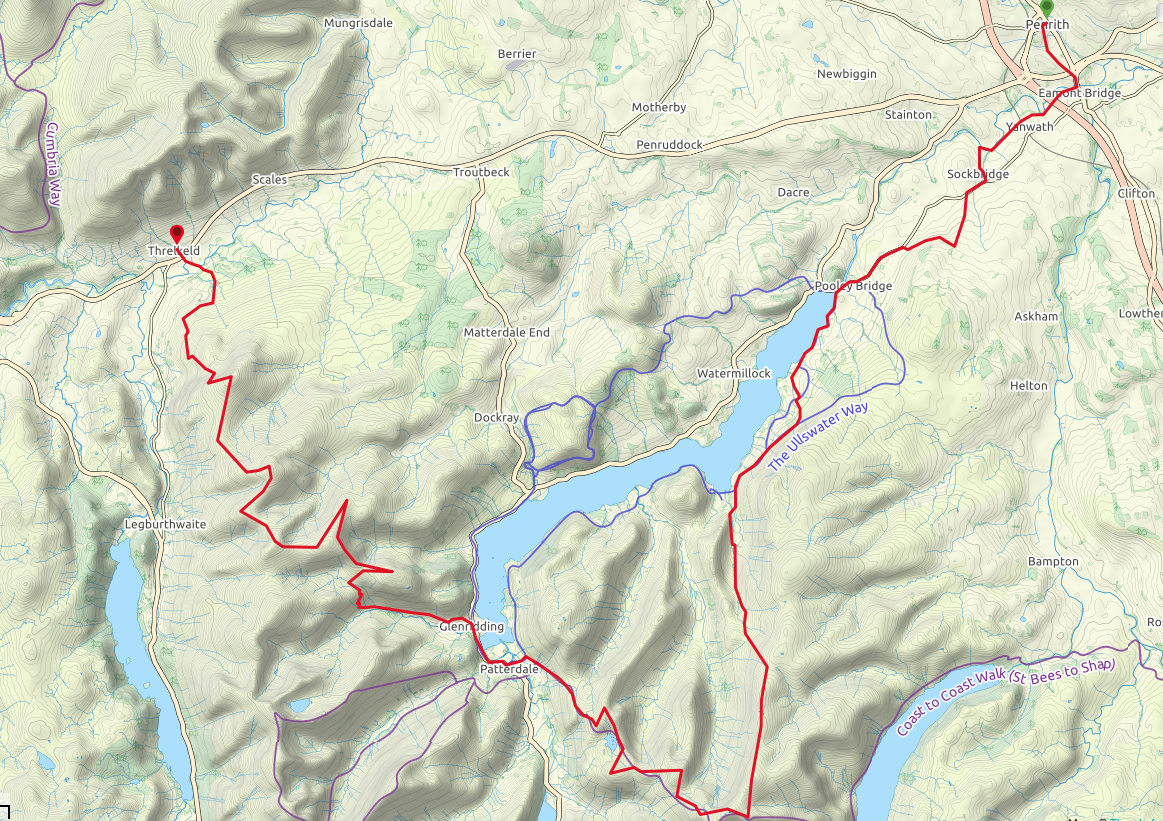
Penrith to Threlkeld, by way of some Elusive Fells

  • Date walked: 24/25th July 2020
  • OS Map: Explorer OL5 – The English Lakes: North-Eastern Area
  • Start/finish point: NY 511 299/NY 322 254
  • Distance: 55km
  • Elevation Gain: 2500m
  • Hills Climbed: High Seat (802m), Kidsty Pike (780m), Rampsgill Head (792m), The Knott (739m), Rest Dodd (696m), Brock Crags (561m), Angletarn Pikes (567m), Sheffield Pike (675m), Hart Side (756m), Stybarrow Dodd (843m), Watson’s Dodd (789m), Great Dodd (857m), Clough Head (726m)

Lakes 1

I’m a fan of coming up with long (perhaps idiosyncratic) walks, joining up hills that I have either missed on previous trips, or would perhaps be a little awkward for me to get to generally. It also makes me feel like I’ve ‘had my money’s worth’ so to speak, given that it takes so long for me to get places on public transport.

And so it was that I set off from Penrith with a plan to walk some of the High Street Roman road (or at least as near to it as you can in the 21st century) and then head off somewhere near High Raise and do a few of the Far Eastern Fells. I strode out of Penrith with a spring in my step, following footpaths through farm fields, the fells teasing me on the horizon. After a while, it became road walking, and I half planned to walk up to Celleron then up on towards ‘The Cockpit’ and on to the fells, some of which I had walked before. In fact, I got to Celleron then suddenly had a change of heart – why not drop down into Pooley Bridge, then walk some of the Ullswater Way? I could always hit the fells somewhere above Howtown.

And so that is how I found myself wandering, one early summer evening, along the path above Ullswater, happy as a pig in muck.

Penrith to Threlkeld

Penrith to Threlkeld

Once past Howtown, I entered Fusedale for the first time – and what a glorious valley! The good path took me gradually along Fusedale Beck and then gradually climbed, and climbed, and climbed, emerging on Wether Hill – hey presto, I was back on the Roman Road. The sun was getting lower in the sky, and up a height the temperature dropped substantially. My mind turned to a bed for the night, but not before bagging Kidsty Pike, Rampsgill Head, and the rather shapely Knott.

Penrith to Threlkeld

Penrith to Threlkeld

Descending The Knott, I found a lovely little flat area overlooking Rest Dodd, and caught sight of several deer. Tent up, perfect spot. Throughout the night the deer came close to the tent and made the most terrifying noises – who’d have thought Bambi would sound like something from a horror film? Very early the next morning I breakfasted in the rain then tackled Rest Dodd head-on, before dropping down towards Brock Crags, along by Angle Tarn, then somewhat awkwardly up to Angletarn Pikes and its list of summits.

As a side note, I was delighted at my previous night’s pitch high up on Knott, and counted no fewer than 17 tents dotted around Angle Tarn. I also counted no fewer than 6 bum cheeks going about their morning movements by the tarn, and found myself feeling a little angry at my fellow man. Or perhaps just bitter that I have braved all manner of uncomfortable conditions in the hills, attending to business far away from my tent, far from paths, digging little holes. At Angletarn-by-the-sea they were only a burger van away from being a resort. Anyway, onwards.

Penrith to Threlkeld

Penrith to Threlkeld

Penrith to Threlkeld

Penrith to Threlkeld

I say onwards, I came across another pair of cheeks at the Boredale Hause ‘junction’, tutted as the cheeks retreated through the tent flaps, then made my way down to Glenridding. Time to adjust myself, attend to aching feet, get rid of rubbish (in a bin, fancy that), before making my way up to the Greenside Road and along the busy path we all know so well.

Penrith to Threlkeld

I stopped to watch the lines of people snake their way up towards Helvellyn, and then left the path to head up to my own private fells, up Stang End and through the interesting remnants of mining works, to make my way to Sheffield Pike. Back down to the path, and then steeply up Glencoyne Head, I was off across to the rather inconveniently situated Hart Side, when the mist suddenly rolled-in and the landscape looked more like it usually does when I’m in the hills.

Penrith to Threlkeld

Penrith to Threlkeld

Penrith to Threlkeld

Next on to the Dodds. The mist cleared every now and then to give me little glimpses of Thirlmere, and by the time I arrived at Watson’s Dodd (an underrated fell in my humble opinion…) the conditions were excellent. I lingered at Watson’s Dodd, and not just because of the name.

Penrith to Threlkeld

Penrith to Threlkeld

The rest of the walk was straightforward, gentle walking – Great Dodd, Calfhow Pike, then straight up the (wet) side of Clough Head. This latter fell has teased me so many times when I’ve travelled by bus into Keswick, it felt great to have conquered it at long last. But it soon conquered me, because the steep descent down the screes made the ending to the walk rather more dramatic and telling on the knees than I would have liked. Great views, though.

And so I snaked my way down to Threlkeld, and had a pint while waiting for my bus, chuffed that I could now tick off a whole bunch of beautiful fells. Fells that have been teasing me for months. Cheers!

Penrith to Threlkeld

Penrith to Threlkeld

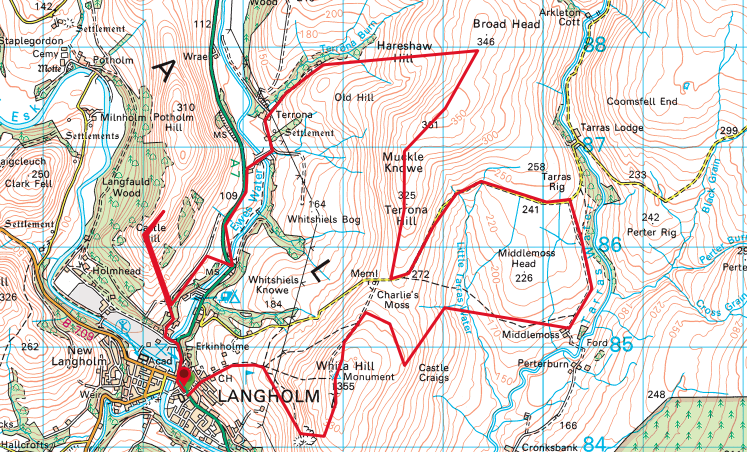
Langholm – Round Two (Bivvy Bag Adventures)

  • Date walked: 28th July 2020
  • OS Map: Explorer 323 – Eskdale & Castle O’er Forest
  • Start/finish point: NY 364 865
  • Distance: 20km
  • Elevation Gain: 833m
  • Hills Climbed: Whita Hill (355m), Muckle Knowe (361m)

Langholm 2

Langholm is fast becoming one of my favourite spots for walking nearer to home. Here, just a few miles over the border into Scotland, are seemingly endless rolling hills to explore, and the fact I can get here so easily on public transport means it is a wonderful area for overnight escapes. And so, having explored a few hills west of the town a few weeks ago, I headed up one fine July afternoon to take in some hills to the east. I rolled up the bivvy bag and set off on a mini adventure.

It was early evening when I started plodding up the steep track out of Langholm and up to the popular Whita Hill, with its impressive Malcolm Monument. I met a few other people on the path, seemingly locals walking dogs or else going for evening strolls on this modest hill. The views from the top as the sun began to get lower in the sky were excellent.

Langholm

Langholm

Langholm

Leaving the summit of Whita Hill, I followed the path down and around the ‘back’ of the hill, onto a heathery nature reserve. Once past the cairn at Castle Knowe, I struck off into the deep heather and walked roughly in a straight line toward the little ford marked on the OS Map. Some very pleasant (if slightly squelchy) walking followed on the path and over some footbridges to reach the farm track above Middlemoss. Tinnis Hill was looking very attractive in the distance, but perhaps a little too far for a bivvy tonight, so I somewhat aimlessly joined the road at the end of the farm track. I could have continued along to Tarras Water to find somewhere to sleep, but in the end just opted for some heathery slopes under Terrona Hill, unfurled the bag, and settled in for the night.

Langholm

Langholm

Langholm

Though I have frequently been an unlucky camper when it comes to weather, I am yet to have a bad night in a bivvy bag. It was warm but with just enough breeze to keep me comfortable, the heathery mattress was a delight, and the night sky was just something else. Granted, an owl kept swooping at me for the first half hour or so (I suppose I looked like its biggest meal ever, in my bag) but after that it was all meteors, satellites, clear skies, stars that seemed to multiply every time I took a breath and relaxed deeper into the heather. Next morning, I was packed and ready to go in a matter of minutes, then left the road and headed up the boggy ridge to Terrona Hill and Muckle Knowe.

Langholm

I didn’t feel I had time to head on to Hog Fell, so left the path (or at least the fence) somewhere over Hareshaw Hill, and made my way steeply (and roughly) down through a heathery no-man’s land towards Terrona Shiel, then hit the track to Terrona Farm and then followed the A7 towards Langholm – luckily quite quiet at this time of the day. At Highmill Bridge I noticed a footpath not marked on the map, which seemed to offer a way onto Castle Hill, so up I went. Turns out it led to an old track, towards Pathhead. Once there, I decided to climb the steep little climb up to Castle Hill, where I stopped for breakfast and some views back over Langholm. No time to head onto Potholm Hill today, so I dropped gently back down the way I had come, and strolled into Langholm where I donned my face mask and hopped on the bus, and on to Newcastle just about in time to start work.

Langholm

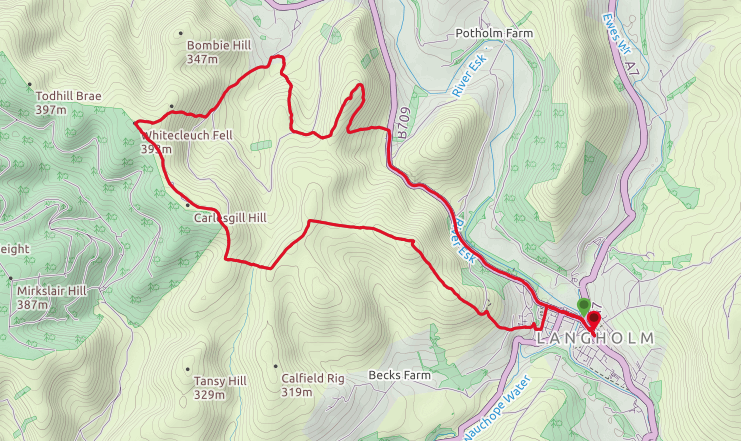
A Handful of Langholm 300s

  • Date walked: 8th July 2020
  • OS Map: Explorer 323 – Eskdale & Castle O’er Forest
  • Start/finish point: NY 363 846
  • Distance: 17km
  • Elevation Gain: 579m
  • Hills Climbed: Mid Hill (326m), Whitecleuch Fell (393m), Craig Hill (314m)

Langholm

I recently finished reading Julian Glover’s excellent biography of Thomas Telford, the great British engineer, and noticed that Langholm featured heavily. Not only was this little town in the Scottish borders the place where Telford was born and served his apprenticeship, the whole area seems to be infused with history – great engineers aside, we have poets, statesmen, soldiers, explorers. There seems to have been something in the air in this neck of the woods, and I wanted to experience it for myself. Train to Carlisle, bus to Langholm, here we go.

Langholm is surrounded by hills. Not mountains. Just hills. Lovely mini Donalds, in a way. Hills as far as the eye can see. There’s a whole bunch of hills that reach or exceed 300m, and I decided to have a stab at Mid Hill, and see where my fancy took me. There’s safety on low hills, and safety breeds nonchalance.

I plodded straight out of New Langholm and up to Meikleholm Hill – a solid plod up a steep hillside, where views soon unfolded, and thighs soon burned. From here it was very Donald-ish – following slightly boggy fences over rolling hills. Soon I arrived at Mid Hill, and I felt like I’d just plodded up an Ochil Law. Or perhaps a mini Crianlarich Ben More. In any case, I took a break. Hello, Eskdale, hello Mr Telford.

Langholm

Onwards to Black Knowe, where some frisky cattle urged me westwards, and I tried to work out what on earth my plan was. Craig Hill? Nah, do that later. Let’s go along to Craighope Head, then drop down into the cleugh. Drop down, he says. Nobody walks this way, so it was full Jurassic Park for the fern-negotiating tumble down into the cleugh. Arms above head, very awkward, also very hot and sweaty. Then it was straight up the other side, where eventually I reached another God-given fence and pulled myself up towards the next hill. Craig Wind Farm sits atop Clagberry Hill, and though I missed the trigpoint, I did get some lovely views to the east into Telford country.

Langholm

Langholm

I toyed with heading to Calkin Rig, the Marilyn that seems to be there for no other reason than to tease hillwalkers who are reliant on public transport, but if I’m honest, I was knackered. There’s no ‘just’ in just walking the little hills around Langholm. I decided to bag the rough and midge-ridden Whitecleuch Fell, then dropped steeply down the fern-covered slopes to the track under Black Knowe.

Langholm

Langholm

Once on the track, my improvised route took me to a little ford, where I switched back and headed up the steep grassy slopes of Torbeck Hill, and then gained Craig Hill, the hill that eluded me earlier. Gotcha! From here, I trudged south-east down the steep slopes towards Craigcleuch South Lodge (more interesting history, if you get on the old Googler as you hike…), from where it was an easy few km walk along the minor road (why do people drive so aggressively on small country roads?) to Langholm.

I just had time to pop down to the river Esk, where I dipped a toe and watched a man drinking cans of industrial strength cider. Perhaps the same kind of cider the likes of girder-meister Telford imbibed. Alcohol aside, there really is something about this part of the world.

And I love it.

Langholm

St Abb’s Head – ‘Sea View Figure-of-Eight’

  • Date walked: 27th June 2020
  • OS Map: Explorer 346 – Berwick-upon-Tweed
  • Start/finish point: NT 919 672
  • Distance: 9km
  • Elevation Gain: 259m

St Abb's Head

This delightful walk marked my first time over the border since early 2020. Restrictions were still in place, so we didn’t travel too far north, but were surprised at just how many people had had similar ideas. There is stunning coastal walking to be had north of Berwick upon Tweed, and this bright, warm, but pleasantly breezy day was perfect for stretching the legs around St. Abb’s Head.

The walk pretty much follows Walk 17 in Alan Hall’s excellent ‘The Border Country: a Walker’s Guide’ for Cicerone Press, from whom I have stolen the title. Starting in St. Abb’s itself, the walk follows good coastal and cliff-top paths around Kirk Hill to St. Abb’s Head, before returning alongside Mire Loch, a beautiful freshwater loch tucked-away almost out of sight until you’re pretty much beside it. Back in St. Abb’s, we walked along to Coldingham Bay, a pretty little bay complete with brightly painted beach huts, before returning to the car park in St. Abb’s via the Creel Road.

St Abb’s Head

St Abb’s Head

St Abb’s Head

St Abb’s Head

One of the highlights of the walk was reaching the lighthouse at St. Abb’s Head itself. Perched on the clifftop, the lighthouse is not open to the public (and in fact the old lighthouse keepers’ cottages are now privately rented holiday cottages) but you can get pretty close, and you have to admire the engineering feats executed so deftly by the famous Stevenson family.

This is a walk of contrasts and has something for everyone  –  sweeping sea views, clifftop walking, myriad flora and fauna, a sheltered lochside path, pretty bays and coves. And what a wonderful way to finally creep north of the border. Let’s hope we can keep on edging northwards…

Seathwaite Fell & Allen Crags

  • Date walked: 5th July 2020
  • OS Map: Explorer OL4 – The Lake District: North-Western Area/OL5 – The Lake District: South-Western Area
  • Start/finish point: NY 235 121
  • Distance: 14.5km
  • Elevation Gain: 743m
  • Hills Climbed: Seathwaite Fell (632m), Allen Crags (785m)

Seathwaite Fell

This was intended to be walk 5.4 in my Nuttall guide, with Glaramara being the main event, but there was a question mark over the whole walk from the moment we left Gateshead on a wet Sunday morning. Forecasts were ‘interesting’ and we knew the wettest place in England would be, well, pretty wet, but we thought it was worth a look anyway.

How very wet it was. And windy. And pretty cold. And grey. We were drowned rats before we even left Seathwaite Farm. But we plodded onwards. As did several other parties, one of them a pair of young walkers who were planning to climb Scafell Pike. We pointed them in the right direction (or at least a direction) and started the walk up to the very pretty Stockley Bridge. We were chatting about Wainwright bagging as we walked in the driving rain, and the conversation turned to one Paul Tierney, the guy who ran all 214 Wainwrights last year in a record six days or other. Just then, a group of damp fell runners passed us at a little ford. “That’s only Paul Tierney!” I exclaimed. Mr Tierney didn’t hear me, but did say hello as he jogged on by. I felt oddly chuffed to have seen him, a celebrity of the fells, and laughed at what our reaction might have been if AW himself had been around today, and we had bumped into him! Anyway, we crossed the bridge and headed up towards Taylor Force waterfall, all the while scanning Aaron Crags – my guide said to strike out onto the pathless slopes about 300 yards along the path after the plantation ends, but no matter which way I looked at Aaron Crags it seemed like a pretty tough slog up to Wainwright’s summit at 601m. We decided that my (non-peak-obsessed) friend needn’t go through the steep slog, so we arranged to meet at Sprinkling Tarn – she carried on along the path, I headed up to the summit.

Seathwaite Fell and Allen Crags

Seathwaite Fell and Allen Crags

The summit plateau of Seathwaite Fell, with its three tops, reminded me a little of Tarn Crag, and I felt oddly at home already among the knobbly mounds and pretty little bodies of water. The weather conditions were pretty rough, and cloud cover meant the views form the true summit cairn were limited, but I decided I like this fell and it was a shame that an inability to stand up in the wind mean I couldn’t hang around. Soon I dropped down to Sprinkling Tarn, and once reacquainted with my pal, we headed on up the path.

Seathwaite Fell and Allen Crags

Seathwaite Fell and Allen Crags

Seathwaite Fell and Allen Crags

We bumped into our two young friends from the start of the walk, who had climbed Ruddy Gill and got as far as the shelter under Broad End, before calling it a day because of weather and visibility. They also thought they were at Sty Head, and were rather confused, so we spent a while chatting in the rain and sent them back off the way we had come (or at least the way my friend had come) and said our goodbyes. Lovely lads, on their first lakeland walk, and it reminded me of my own baptism(s) of fire in Scotland, soaked to the skin, and wondering what on earth I was doing. I hoped today didn’t put them off, and suggested a few walks and small fells they might consider on the way back home.

But soon, we found ourselves in a similar position to the lads. It had gone rather dark, other walkers seemed to have evaporated, and as we plodded up to Allen Crags, we were treated to hail and stinging faces. Do we continue to Glaramara? Or do we drop down Ruddy Gill and agree that discretion is the better part of valour? We opted for the latter, and reluctantly retraced our steps and dropped down to follow the Ruddy Gill path all the way back to Seathwaite.

Seathwaite Fell and Allen Crags

This was to be just the second time in 135 Wainwrights that I had been defeated (or sternly discouraged…) by weather conditions, and I also knew it wasn’t right to force my pal to plod on when they had come for a walk rather than an expedition.  I found I had to have a word with myself on the way down Ruddy Gill, what on earth was I feeling bad about? A glorious walk in dramatic weather, in one of the most beautiful areas of the country, and somehow not managing to tick all the planned summit boxes made me feel disappointed?! We laughed at the delicious futility of peak bagging, made a few remarks about not seeing the wood for the trees, and the rest of today’s walk was one of two soaked pals, in good spirits, taking what felt like the longest path in Lakeland, admiring views and celebrating that we couldn’t get any more wet.

It was something of a relief when we reached the car at Seathwaite, but it had been a cracking walk. Just not quite walk 5.4.

Oh, and despite what I said above, Glaramara – I’m coming for you…

Seathwaite Fell and Allen Crags