Hareshaw Linn

  • Date walked: 1st January 2021
  • OS Map: OL42 – Kielder Water & Forest
  • Start/finish point: NY 839 833
  • Distance: 6.97km
  • Elevation gain: 132m

During lockdown I have explored a lot of places in Northumberland, but am ashamed to say I hadn’t heard of Hareshaw Linn until very recently. Perhaps because I try to avoid tourist hotspots where possible, perhaps because there is so much more to the beautiful county of Northumberland than I ever thought. I decided to stride into the New Year with a spring in my step, and headed across to Bellingham on New Year’s Day.

Bellingham is a pretty village in the centre of Northumberland, the River North Tyne running to its south, the military ranges and expansive moorland opening up to its north. There is a free car park at the start of the popular path to Hareshaw Linn waterfall, but for public transport users there is also an excellent public transport service in this part of the world, with buses connecting Hexham and Bellingham at least every couple of hours. However you get there, you soon find yourself on the easy path north out of the village, and that’s exactly where I found myself this crisp New Year morning.

Hareshaw Linn

The good path soon became muddy and icy in quick succession, and gradually gained height above the burn flowing noisily below. Shortly I came to the first of several well-constructed wooden bridges (the first of six, if I recall) that cross the burn as the path winds its way further up what can, by this stage, safely be called a gorge. For a wintery day during lockdown, I was perhaps surprised at the number of other visitors and walkers, but then it was New Year’s Day and of course this is (so I learned later) a beauty spot that features on many ‘must visit’ lists of Northumberland locations.

Hareshaw Linn

Some slippery rock steps negotiated along the way, and one or two small, appetiser, waterfalls encountered, I found myself at a high vantage point with the magnificent Hareshaw Linn revealing itself through the trees ahead. The gentle walk up the gorge had taken about an hour. The roar of the falls was tremendous, and the cliffs on either side of the gorge rose to giddying heights. A pool at the base of the falls completed the idyllic picture (I’m sure in summer this place is heaving with visitors, many of whom will doubtless take a dip), and a series of stone steps led the way down to the waterfall itself.

Hareshaw Linn

With my waterproof coat on, and hood up, I scrambled down to get even closer to the waterfall and enjoyed the odd sense of silence and calm that comes from one of the loudest forces of nature. I could have stood there for hours, but a fairly steady stream of visitors was arriving at the falls and I’m sure they didn’t all want me standing in their photographs.

Hareshaw Linn

Reluctantly, I peeled myself away from the waterfall and headed back up the pretty stone staircase to the path. The return walk is by exactly the same route, and so the whole walk came in at around two hours, allowing for plenty time to admire scenery and eat sandwiches. Hareshaw Linn is a remarkable sight, and such an unexpected surprise given the sprawling moorland that surrounds on almost all sides of the area. I can’t wait to return – in all weathers – to again pay my respects to one of the most impressive and powerful wonders of Northumberland.

Hareshaw Linn

The Blue Lagoon, Frankham Fell, & Carr Edge

  • Date walked: 29th November 2020
  • OS Map: Landranger 87 – Hexham and Haltwhistle
  • Start/finish point: NY 888 679
  • Distance: 9.25km
  • Elevation Gain: 178m
  • Hills Climbed: Frankham Fell (182m)

Who knew that Northumberland has its very own ‘blue lagoon’? Certainly not me, but I think I might have been in the minority, if news reports are anything to go by. Apparently this little ‘beauty spot’ has been the site of many a trespass, much disturbance and antisocial behaviour, even more littering, and a fair few illegal ‘wild’ camps. People have been swimming in the lagoon, and when you first catch sight of the pool of emerald water, you can perhaps understand why. The thing is, it is contaminated, and it is dangerous. It is also on private land, and while surrounded by public footpaths, following the track running through the disused quarry and past the infamous lagoon is in itself an act of trespass. We left the car at the little village of Fourstones (near Hexham), followed a track up toward the old quarry, and made the decision to pass through the site. A short, discrete, respectful detour from what would be a longer walk on public rights of way, we decided we could live with ourselves.

There seem to be two theories behind the cause of the striking, emerald coloured water in the lagoon. One suggests the hue comes from the mineral content of the rock, another that a bearing from an old crane has contaminated the water. Whatever the truth, the lagoon makes for a striking reveal as you approach from the woodland track. We lingered a few short minutes, and walked past yet more signs reminding us we were not on public land, before heading up and away from the site. Passing a couple of local dog walkers made us feel a little better about the trespass, and before leaving the woodland we briefly visited the unremarkable, overgrown summit of the obscure little hill named Frankham Fell. Joining the public footpath, we headed east then eventually joined the minor road north (surprisingly busy), finally leaving the road at NY 891 698.

The path leads into Carr Edge Plantation, which in itself seems like a small and unremarkable forestry site, but we noticed a monument marked on the map and, intrigued, sought it out. A beautiful little clearing revealed itself, and a large stone cairn stood ahead. On closer inspection, we discovered this was the site of the very first scout camp led by none other than Baden Powell himself, back in 1908. What a find!

We spent longer at this site than at the lagoon (there are two bench seats, too), only moving when we realised the sun was already very low in the sky. Enjoying the beautiful shades of autumn a few minutes longer, it was time to leave the woodland, following the footpath down into farm fields, Hadrian’s Wall country on the near horizon.

The light was fading fast, and our pace picked up accordingly. A very pleasant path took us along to the farm at Carr Edge, soon joining a track south in the direction of the village of Newburgh. At NY 874 685 we considered taking the public footpath through the fields back towards the quarry site, but the going looked extremely muddy, the light had already gone, and the sunday strollers in us led us to keep the head torches in the pack, and stay with the roadside path into Newburgh. Lockdown of course meant that stopping off at the very pleasant Red Lion pub couldn’t happen (in a pre Covid-19 world, I enjoyed ending a couple of walks in this area with a pint of ale here), so we took a left at the village junction and followed the good pavement, in the dark, back along to Fourstones.

All in all, a nice little wander in this picturesque part of Northumberland, and if you can forgive yourself a moment of trespass, I’d recommend giving it a go. Perhaps just wait until the pub is open again, and you’ll be doubly glad you savoured another local gem.

Haydon Fell (In the Footsteps of John Martin)

  • Date walked: 16th August 2020
  • OS Map: Landranger 87 – Hexham & Haltwhistle
  • Start/finish point: NY 842 645 (Haydon Bridge Railway Station)
  • Distance: 8km
  • Elevation Gain: 219m
  • Hills Climbed: Haydon Fell (246m)

When circumstances and a certain lockdown have conspired to keep me away from the mountains, I’ve spent time investigating local walks and bagging the many modest hills nearer to home. A glance at the ‘show all hills’ option on hill-bagging.co.uk reveals a host of Tumps and smaller mounds, and Haydon Fell had been on my list for a while – the one remaining hill in the Tyne Valley my boots were yet to come into contact with.

And so one afternoon I found myself hopping off the Newcastle-Carlisle train at Haydon Bridge, from where I headed straight up to the public footpath to The Tofts. This right of way is dead straight, up the steep little hillside where views soon open up south across the Tyne Valley. After a short and stiff pull up to the farm, I took a moment at the finger post and first noticed a little sign announcing this was part of the ‘John Martin Heritage Trail’.

Haydon Fell
Finger post announcing the John Martin Heritage Trail

I’ve been a fan of the work of Romantic painter John Martin (1789-1854) for many years, but I’m ashamed to say I’ve never taken time to research the man himself, so while I knew he hailed from the north east I didn’t know he was born in the tiny village of Old Haydon. This master of the epic biblical scene spent his childhood around Haydon Bridge, and attended Sunday School at Haydon Old Church, where today’s walk would eventually take me.

The Destruction of Sodom and Gomorrah (John Martin)
The Destruction of Sodom & Gomorrah (1852)

Turns out the Heritage Trail is in two parts, with section one running for just two miles from Haydon Bridge to the aforementioned Old Haydon, and the second section being a ten-mile walk to the south of Haydon Bridge, following in the footsteps of a young Martin. Definitely worth a return to follow the whole trail, and more information can be found here.

From The Tofts there was now a stretch of road walking, gradually uphill to Westley Bank, and on to a crossroads, where another finger post ushered me over a stile and onto a public footpath towards the summit of Haydon Fell. The ground here was more tussocky heath, and the right of way took me on diagonal straight across the fields to another stile in the wall. I passed the remains of some concrete buildings, and wondered what they were. A little research suggests they are the remains of WW2 watch posts, and with the good views back across Tyne Valley, I can see why.

Haydon Fell
On the way to Haydon Fell
Haydon Fell
Looking back across the Tyne Valley

The summit of Haydon Fell is unremarkable in itself, simply the highest point in a large field of sheep and cattle. The presence of a huge bull was a little disconcerting, but he seemed much more interested in his harem than in me, so I gained the summit with a little help from the OS Maps app, and then hastily made for the trigpoint further away across the field. The views east from the trig were pleasant, and it was well worth taking a little break to admire the vista. From the trigpoint I joined a rough farm track towards the minor road, pausing to wonder at yet another interesting building, whose purpose I have no idea about.

Haydon Fell
The trigpoint on Haydon Fell
Haydon Fell
The mystery building

The pleasant walk along the minor road (fortunately devoid of any traffic) took me downhill to West Haydon Farm, then zigzagged down to Page Croft, where a bench offers excellent views back down to Haydon Bridge itself. It was here that the John Martin Heritage Trail raised its head again, and I took the short detour from Page Croft across the hillside to Haydon Old Church (marked simply as a cross on the OS map). This was a beautiful little find! An information board explained a little about this son of Haydon Bridge, and revealed that the simple little church (sadly locked, doubtless due to Coronavirus) was built in the 12th century, and was where the young John Martin attended Sunday school, and twice-daily services – little wonder biblical themes formed so much of his output! The austere building sits in a beautiful little churchyard, and is well worth taking the time to explore.

Haydon Fell
Haydon Old Church
Haydon Fell
The view from Page Croft

Retracing my steps across the field to Page Croft, it was now quite steeply downhill on the minor road again, until I passed under the railway line and emerged on a pretty riverside path leading into Haydon Bridge. The old bridge takes you straight across the Tyne, and quite conveniently leads to the Anchor Hotel, where I decided it would be rude not to take a drink. From here it was a short hop back across the river to the railway station. All in all the walk took just two leisurely hours, and is fairly easy, for all the surprising amount of ascent and descent. Next stop, the John Martin Heritage Trail proper.

Haydon Bridge
Haydon Bridge

Lindisfarne – Finishing St Oswald’s Way

  • Date walked: 13th June 2020
  • OS Map: Explorer 340 – Holy Island & Bamburgh
  • Start/finish point: NU 076 424
  • Distance: 15km
  • Elevation Gain: 36m

Holy Island

St Oswald’s Way is one of those long distance walks I’ve been chipping away at for almost a year. Despite some moments of outstanding beauty, and perhaps because much of it is on territory quite close to home, it isn’t a route that I’ve felt drawn to other than as occasional day walks. But much like hill bagging, there is an itch that needs to be scratched and having somehow walked all the stages of SOW as far as Beal, there was just the one glorious, closing section to do – the crossing of the sands to the holy island of Lindisfarne…

The entire north east of England seemed to be under a thick blanket of fog this particular weekend, which in part made the decision to do this walk easier – not great for hillwalking, but eerily perfect for estuary walking, Maybe I read too much Erskine Childers as a boy. We parked on the road side near Beal Sands (car parks still being closed across Northumberland) and moments later had struck out onto the causeway. We decided to cross the sands by the ‘Pilgrim’s Route’ which is a direct line across the mud flats, following regularly spaced wooden posts. A more otherworldy atmosphere I haven’t experienced in some time. The mud was at times so soft so as to feel like it could give way to quicksand, but navigation is easy, and there are a few refuge huts for stranded walkers dotted along the route. Not that we were in any danger today, the tide was scheduled to be out for a very long time, and the sands were to be safe for an unusual window of some 10 hours or so.

Holy Island

Holy Island

It’s a very odd feeling, walking across the sands when you can’t so much as see the even the road causeway nearby. The posts mean you can’t get lost, but you can feel quite disorientated. Expecting wet feet, I was trying out a new pair of walking sandals, which are perfect for this type of walk. They also added to the pilgrim feels.

Holy Island

Holy Island

Eventually the hazy outline of Holy Island appeared from the mist, and we had struck land. Time for a little break on the well-made bench, and a read of the information boards. Apparently this area was used for bombing practice during WW2, and there are signs encouraging you not to touch any objects you may come across in the sands or on the headland – they ‘may explode and kill you’. What, with Murton Fell last week, and Bomber Command playground this week, I could start a line in military walking tours…

Holy Island

We walked through the deserted village streets and took a path past the priory, crossing the beach to a small island where St Cuthbert once had a monastic cell. A large wooden cross marks the site now, and we sat a while looking out to sea, watching seals and all manner of seabirds occupy themselves.

Holy Island

Returning to the main island, we followed the footpath to the northern edge of Holy Island, where fields of sheep meet sand dunes, and the occasional deer (looking quite out of place) pops its head above the long grass. It looked like a botanist’s paradise, but I don’t know the first thing about flora so just admired the colours and enjoyed the wet grasses brushing my legs. Soon we arrived back at the causeway, where, for the sake of variety, we decided to walk back on the actual road causeway rather than retrace the path across the estuary. The causeway takes you over ‘The Snook’, a smaller, secondary island with, apparently, some interesting buildings on it, but we stayed with the road and eventually arrived at the refuge hut designed for stranded motorists. From here, it was a short walk back to the car, with a couple of satisfied nods at having completed another long distance route.

And I must say, I felt like quite the little pilgrim.

Holy Island

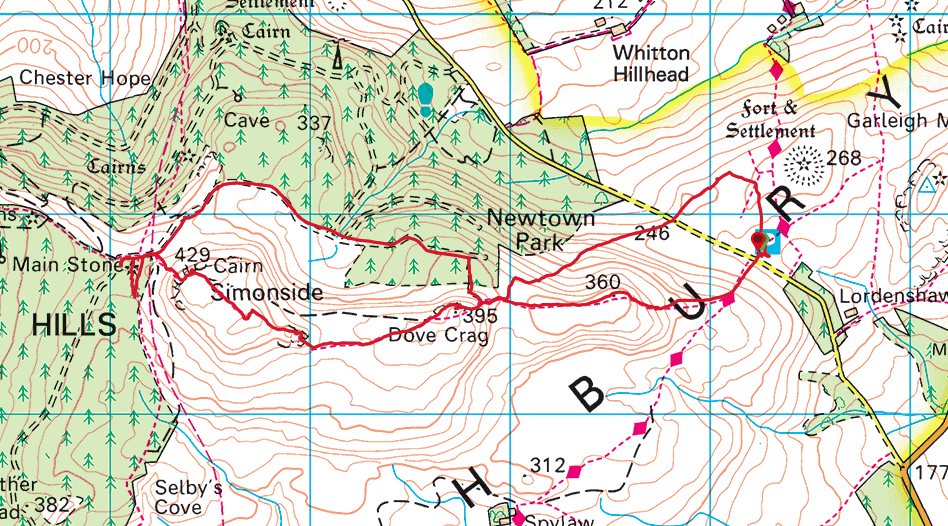
A Windy Wander on Simonside

  • Date walked: 23rd May 2020
  • OS Map: OL42 – Kielder Water & Forest
  • Start/finish point: NZ 052 987
  • Distance: 9.3km
  • Elevation gain: 321m
  • Hills Climbed: Simonside (430m)

Simonside

This was a good few weeks ago now, so I thought a brief ‘photo report’ might be the order of the day. This was one of several walks closer to home during lockdown, before we were able to head to the bigger hills. I’m embarrassed to say this was my first time in the Simonside Hills, but as I’m sure is the case for many of us, it was good to discover beauty spots almost on the doorstep.

It may be of interest to others that the tree felling shown in one of the photos below, just as we had descended from Simonside, meant the path marked on the OS map heading south at NZ 021 987 (and so the path we hoped to use to make the walk a larger circular, meeting St Oswald’s Way) was non existent, and the ground very difficult to negotiate. In the end we returned to the good track and went back in a figure of eight.

Do take time, when back at Lordenshaw car park, to investigate the cup and ring marked rocks in the area. This part of the world is steeped in ancient history, and they are bound to set the imagination going…

Simonside

Simonside

Simonside

Simonside

Simonside

Simonside

Simonside