The Red Kite Trail

  • Date walked: 23rd January 2021
  • OS Map: Explorer 307 – Consett & Derwent Reservoir/Explorer 316 – Newcastle upon Tyne
  • Start/finish point: NZ 185 608
  • Distance: 21.73km
  • Elevation gain: 296m

With January being all about staying local, revisiting the paths I’ve walked many times and trying to see them through new eyes, I was beginning to think I’d explored pretty much everything there is to see around Gateshead. Granted there are always occasional rights of way you spot when poring over the OS map, and can’t quite remember if you’ve trodden them or not, but in terms of longer, more ‘interesting’ walks, I was perhaps getting tired. Thank goodness for Viewranger, then. In ‘Outdoors Map’ mode, I’ve noticed that all manner of labelled paths and longer distance walks are shown, some of which don’t appear on the OS map – other than as various green lines. So, we’re au fait with the Tanfield Railway path, we’ve walked the Bowes Railway path a dozen times, we’ve done the large and impressive loop that is the Tyne & Wear Heritage Way – 128km of local underfoot goodness – in both directions. Then there’s the Red Kite Trail.

The what?

Yes, the Red Kite Trail. Perhaps I missed the memo, perhaps everyone has walked it a million times, perhaps I’ve just been blind to the way markers. In my defence, though I’ve lived in Gateshead for eight years, I’ve been walking for only a quarter of that time. Perhaps I’m still young, fresh, and ignorant. Well, certainly not young. Whatever the case, the Red Kite Trail is a delicious circular walk of about 20km taking in a stretch of the popular Derwent Walk, a tantalisingly short foray into the ever more popular Chopwell Wood, before heading up onto some high level (for Gateshead) farmland above Rowlands Gill, eventually dropping back down to your starting point at Winlaton Mill. Of course this is well known for being red kite territory – some 94 of these majestic birds of prey were reintroduced to the Derwent Valley between 2004 and 2009, and they seem to thrive. Many’s the time I’ve glanced up from my map on hearing the kite’s distinctive call, and watched one or two birds glide just above the treetops. They have their own walk, and I decided to explore for myself.

The Red Kite Trail

The walk starts at the wonderfully named Land of Oak & Iron, a local heritage centre with a substantial car park. The centre was, of course, closed due to a certain lockdown, but the car park was open, free, and not gated. This spot is well served by public transport, too: Go North East have all the answers.

This was one of those mild but frosty mornings we’ve had so many of lately, a little crunchy underfoot and the sun shining brightly most of the (short) day. A plethora of way markers served only to make me feel even more ignorant, and took me through a section of the Derwent Walk Country Park, around Kite Hill (the clues really have been there the whole time) and then soon up onto the Derwent Walk itself. This old railway, repurposed as a multi-use path between Swalwell and Consett, is a path I’ve walked many times, and makes for an easy and at times scenic (especially at the viaducts) plod. Number of red kites seen so far: none.

The Red Kite Trail

The Derwent Walk comes to a halt at Rowlands Gill to make way for a road, which must be crossed, but then I was soon back on the path and wandered another couple of kilometres until finally leaving the railway path above Lintzford. Just the A694 to cross now, then the rest of the walk would be all tracks and paths, or else very minor roads free of traffic. A word of caution – emerging at the pretty hamlet of Lintzford onto the road, I missed any way markers that may have been there, and for some reason followed what felt like the natural course of the path to the left, expecting to cross the road further up and head into the obvious woodland. Turns out a few other people made the same mistake (note the spur on the map above!), and after bothering to check the OS map, we found ourselves wandering awkwardly back down to the actual path – directly over the road from the bridge at Lintzford. An all-the-gear-and-no-idea moment, if you like. Anyway, once over the road I was greeted by a gate, a sign, and a path into Chopwell Wood. Number of red kites seen so far: none.

The Red Kite Trail

Chopwell Wood is a delight. 360 hectares of mixed woodland, with plenty of paths and enough ascent to remind you of more dramatic woods further north in Northumberland, it’s a popular spot for walkers, bikers, and apparently, red kites. The Red Kite Trail touches only the eastern edge of the woodland, the track rising steeply at first before levelling out and offering one or two very good viewpoints over the treetops. Atop one such viewpoint sits a wooden sculpture of a red kite – would this be the only red kite I’d see today? Pausing to enjoy the woodland views, and a sandwich, I did hear the mildly aggressive call of several jays, and caught the odd glimpse of light purple plumage in the trees. Number of red kites seen so far: none, unless you count the wooden one.

The Red Kite Trail
The Red Kite Trail

Onwards. Emerging from the woods, and after a short section of walking on a very quiet road, I arrived at Spen Banks. This smaller area of woodland was largely deserted – once out of the popular Derwent valley, it seems only dog walkers bother to explore here. I got the same kind of feeling I get whenever I watch the hordes ascending Helvellyn from my little vantage point at Stang End. I started thinking of the Lake District – something I keep doing during lockdown, and something I have decided is not healthy. Will we ever get to see lakeland again? My mind returned to the muddy path in front of me, and I kept my eyes and ears open for red kites. Soon the Red Kite Trail merged with the Tyne & Wear Heritage Way, so I was walking familiar territory. Then a little detour. Taking the track north, the RK trail heads up to the little village of Barlow, which at about 170m makes for a surprisingly good viewpoint north. This is the edge of kite territory, and after first questioning the detour, I acknowledged NZ 152 606 would be a perfect spot to linger, hopefully. Number of red kites seen so far: none.

The Red Kite Trail

After the Barlow detour, I followed the way markers back down to meet the heritage way once again, and the two trails became one for the rest of today’s walk. This is all farmland walking, with pleasant views south towards the Derwent Valley. Thornley Bank, High Thornley, Low Thornley, you mark your descent as much with etymology as you do with contours. The light was fading now, but still way markers appeared now and then, seemingly to remind me that I must have been blind not to have seen the RK trail when plodding these paths previously. Number of red kites seen: none.

The Red Kite Trail

The home straight. Once over the A694, the path snakes high above the river Derwent, along Winlaton Scar. I can vouch for one or two quite stunning viewpoints looking through the trees across to Gibside and the Liberty Monument, but by now it was dark and it was much more about negotiating patches of ice, mud, or both. The path drops down to the Derwent Walk Country Park, and soon I found myself on the path back to the Land of Oak & Iron. Where earlier in the day it had been all about looking down at water and frosty bullrushes, now it was about ending the day looking up at silhouetted trees, feeling the tinge of sadness I get at the close of every walk, and pausing to appreciate the beauty to be found on my doorstep.

Number of red kites seen: none.

The Red Kite Trail

The Blue Lagoon, Frankham Fell, & Carr Edge

  • Date walked: 29th November 2020
  • OS Map: Landranger 87 – Hexham and Haltwhistle
  • Start/finish point: NY 888 679
  • Distance: 9.25km
  • Elevation Gain: 178m
  • Hills Climbed: Frankham Fell (182m)

Who knew that Northumberland has its very own ‘blue lagoon’? Certainly not me, but I think I might have been in the minority, if news reports are anything to go by. Apparently this little ‘beauty spot’ has been the site of many a trespass, much disturbance and antisocial behaviour, even more littering, and a fair few illegal ‘wild’ camps. People have been swimming in the lagoon, and when you first catch sight of the pool of emerald water, you can perhaps understand why. The thing is, it is contaminated, and it is dangerous. It is also on private land, and while surrounded by public footpaths, following the track running through the disused quarry and past the infamous lagoon is in itself an act of trespass. We left the car at the little village of Fourstones (near Hexham), followed a track up toward the old quarry, and made the decision to pass through the site. A short, discrete, respectful detour from what would be a longer walk on public rights of way, we decided we could live with ourselves.

There seem to be two theories behind the cause of the striking, emerald coloured water in the lagoon. One suggests the hue comes from the mineral content of the rock, another that a bearing from an old crane has contaminated the water. Whatever the truth, the lagoon makes for a striking reveal as you approach from the woodland track. We lingered a few short minutes, and walked past yet more signs reminding us we were not on public land, before heading up and away from the site. Passing a couple of local dog walkers made us feel a little better about the trespass, and before leaving the woodland we briefly visited the unremarkable, overgrown summit of the obscure little hill named Frankham Fell. Joining the public footpath, we headed east then eventually joined the minor road north (surprisingly busy), finally leaving the road at NY 891 698.

The path leads into Carr Edge Plantation, which in itself seems like a small and unremarkable forestry site, but we noticed a monument marked on the map and, intrigued, sought it out. A beautiful little clearing revealed itself, and a large stone cairn stood ahead. On closer inspection, we discovered this was the site of the very first scout camp led by none other than Baden Powell himself, back in 1908. What a find!

We spent longer at this site than at the lagoon (there are two bench seats, too), only moving when we realised the sun was already very low in the sky. Enjoying the beautiful shades of autumn a few minutes longer, it was time to leave the woodland, following the footpath down into farm fields, Hadrian’s Wall country on the near horizon.

The light was fading fast, and our pace picked up accordingly. A very pleasant path took us along to the farm at Carr Edge, soon joining a track south in the direction of the village of Newburgh. At NY 874 685 we considered taking the public footpath through the fields back towards the quarry site, but the going looked extremely muddy, the light had already gone, and the sunday strollers in us led us to keep the head torches in the pack, and stay with the roadside path into Newburgh. Lockdown of course meant that stopping off at the very pleasant Red Lion pub couldn’t happen (in a pre Covid-19 world, I enjoyed ending a couple of walks in this area with a pint of ale here), so we took a left at the village junction and followed the good pavement, in the dark, back along to Fourstones.

All in all, a nice little wander in this picturesque part of Northumberland, and if you can forgive yourself a moment of trespass, I’d recommend giving it a go. Perhaps just wait until the pub is open again, and you’ll be doubly glad you savoured another local gem.

Langholm – Round Two (Bivvy Bag Adventures)

  • Date walked: 28th July 2020
  • OS Map: Explorer 323 – Eskdale & Castle O’er Forest
  • Start/finish point: NY 364 865
  • Distance: 20km
  • Elevation Gain: 833m
  • Hills Climbed: Whita Hill (355m), Muckle Knowe (361m)

Langholm 2

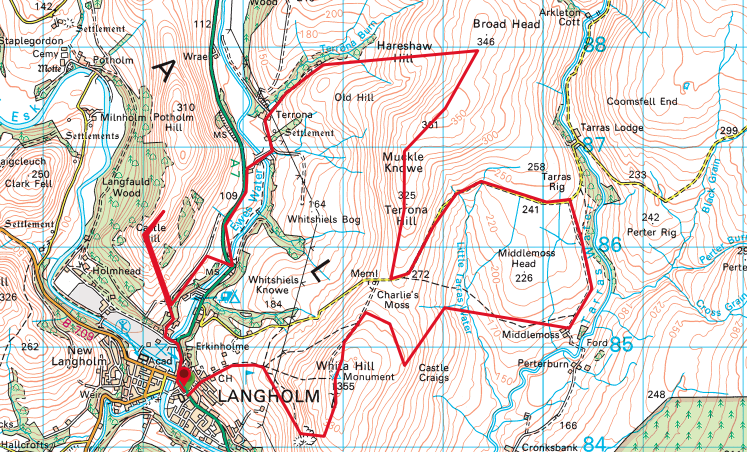
Langholm is fast becoming one of my favourite spots for walking nearer to home. Here, just a few miles over the border into Scotland, are seemingly endless rolling hills to explore, and the fact I can get here so easily on public transport means it is a wonderful area for overnight escapes. And so, having explored a few hills west of the town a few weeks ago, I headed up one fine July afternoon to take in some hills to the east. I rolled up the bivvy bag and set off on a mini adventure.

It was early evening when I started plodding up the steep track out of Langholm and up to the popular Whita Hill, with its impressive Malcolm Monument. I met a few other people on the path, seemingly locals walking dogs or else going for evening strolls on this modest hill. The views from the top as the sun began to get lower in the sky were excellent.

Langholm

Langholm

Langholm

Leaving the summit of Whita Hill, I followed the path down and around the ‘back’ of the hill, onto a heathery nature reserve. Once past the cairn at Castle Knowe, I struck off into the deep heather and walked roughly in a straight line toward the little ford marked on the OS Map. Some very pleasant (if slightly squelchy) walking followed on the path and over some footbridges to reach the farm track above Middlemoss. Tinnis Hill was looking very attractive in the distance, but perhaps a little too far for a bivvy tonight, so I somewhat aimlessly joined the road at the end of the farm track. I could have continued along to Tarras Water to find somewhere to sleep, but in the end just opted for some heathery slopes under Terrona Hill, unfurled the bag, and settled in for the night.

Langholm

Langholm

Langholm

Though I have frequently been an unlucky camper when it comes to weather, I am yet to have a bad night in a bivvy bag. It was warm but with just enough breeze to keep me comfortable, the heathery mattress was a delight, and the night sky was just something else. Granted, an owl kept swooping at me for the first half hour or so (I suppose I looked like its biggest meal ever, in my bag) but after that it was all meteors, satellites, clear skies, stars that seemed to multiply every time I took a breath and relaxed deeper into the heather. Next morning, I was packed and ready to go in a matter of minutes, then left the road and headed up the boggy ridge to Terrona Hill and Muckle Knowe.

Langholm

I didn’t feel I had time to head on to Hog Fell, so left the path (or at least the fence) somewhere over Hareshaw Hill, and made my way steeply (and roughly) down through a heathery no-man’s land towards Terrona Shiel, then hit the track to Terrona Farm and then followed the A7 towards Langholm – luckily quite quiet at this time of the day. At Highmill Bridge I noticed a footpath not marked on the map, which seemed to offer a way onto Castle Hill, so up I went. Turns out it led to an old track, towards Pathhead. Once there, I decided to climb the steep little climb up to Castle Hill, where I stopped for breakfast and some views back over Langholm. No time to head onto Potholm Hill today, so I dropped gently back down the way I had come, and strolled into Langholm where I donned my face mask and hopped on the bus, and on to Newcastle just about in time to start work.

Langholm

St Abb’s Head – ‘Sea View Figure-of-Eight’

  • Date walked: 27th June 2020
  • OS Map: Explorer 346 – Berwick-upon-Tweed
  • Start/finish point: NT 919 672
  • Distance: 9km
  • Elevation Gain: 259m

St Abb's Head

This delightful walk marked my first time over the border since early 2020. Restrictions were still in place, so we didn’t travel too far north, but were surprised at just how many people had had similar ideas. There is stunning coastal walking to be had north of Berwick upon Tweed, and this bright, warm, but pleasantly breezy day was perfect for stretching the legs around St. Abb’s Head.

The walk pretty much follows Walk 17 in Alan Hall’s excellent ‘The Border Country: a Walker’s Guide’ for Cicerone Press, from whom I have stolen the title. Starting in St. Abb’s itself, the walk follows good coastal and cliff-top paths around Kirk Hill to St. Abb’s Head, before returning alongside Mire Loch, a beautiful freshwater loch tucked-away almost out of sight until you’re pretty much beside it. Back in St. Abb’s, we walked along to Coldingham Bay, a pretty little bay complete with brightly painted beach huts, before returning to the car park in St. Abb’s via the Creel Road.

St Abb’s Head

St Abb’s Head

St Abb’s Head

St Abb’s Head

One of the highlights of the walk was reaching the lighthouse at St. Abb’s Head itself. Perched on the clifftop, the lighthouse is not open to the public (and in fact the old lighthouse keepers’ cottages are now privately rented holiday cottages) but you can get pretty close, and you have to admire the engineering feats executed so deftly by the famous Stevenson family.

This is a walk of contrasts and has something for everyone  –  sweeping sea views, clifftop walking, myriad flora and fauna, a sheltered lochside path, pretty bays and coves. And what a wonderful way to finally creep north of the border. Let’s hope we can keep on edging northwards…

A Taste of the Far East

  • Date walked: 20th June 2020
  • OS Map: Explorer OL5 – The Lake District: North-Eastern Area
  • Start/finish point: NY 468 106
  • Distance: 13km
  • Elevation Gain: 807m
  • Hills Climbed: Rough Crag (628m), High Street (828m), Mardale Ill Bell (760m), Harter Fell (778m)

High Street & Harter Fell

With lockdown restrictions continuing to ease in England, my friend Laura and I decided to go that little bit further afield, that extra half hour, to The Lake District. After a few months away from these hills, I was beyond excited as we chugged our way along the A66, poring over the map of what was to be a new area of the LD for me – the Far Eastern Fells around Haweswater. I naively thought it might be quiet in this area of the lakes, but how wrong I was. Mardale Head was certainly the busiest I have ever seen a car park in the area – but thankfully there are so many walking routes, we didn’t see many other people once we left the car park. There was a large tent pitched not far from the car park, and a collection of nature’s finest doing their best to turn one of the most gorgeous starts to a walk anywhere into a holiday camp. Fortunately, it seems they were moved on. But the posts on social media the following day from people clearing up litter in this very spot made me sick.

However, the weather was gorgeous, the conditions crystal clear, and we strode towards The Rigg with smiles on our faces, before doubling back and straight up the Riggindale ridge towards the first objective of the day – Rough Crag. The beginning of the ridge reminded me very much of the Low Pike/High Pike stretch of the Fairfield Horseshoe, and the view back to Haweswater was glorious.

High Street & Harter Fell

High Street & Harter Fell

The path that winds its way to Rough Crag is just exposed enough to be exhilarating, which I don’t think I’d quite expected – it was a wonderful little scrambly journey to the summit, from which the view down to Blea Water and ahead to the Long Stile ridge were quite stunning. Long Stile is a wonderful way up to High Street, it makes for a real mountain adventure on a fell that, once attained, is flat as a pancake.

High Street & Harter Fell

High Street & Harter Fell

High Street & Harter Fell

Once on the famous fell that is High Street, it was easy walking along the Roman route that is High Street, and I was tempted to continue to the beacon on Thornthwaite Crag, given that when I last climbed that hill the weather was poor and the views non-existent. We did enjoy the view cross to Windermere from the Roman road, but decided to stick with the planned route and swung round towards the next summit, Mardale Ill Bell.

High Street & Harter Fell

High Street & Harter Fell

Mardale Ill Bell offers stunning views back towards Haweswater Reservoir, and we had ourselves a lunch break in a sheltered spot shy of the summit. More easy walking on a good path took us down to the head of the Nan Bield Pass, before we plodded straight back up the ‘other side’ to climb Harter Fell, my 126th Wainwright. This really is a glorious horseshoe walk, and I felt I had underestimated the rocky, dramatic beauty of some of these Far Eastern Fells.

High Street & Harter Fell

High Street & Harter Fell

From Harter Fell it was an easy descent on the more grassy slopes (and good path) to Gatesgarth Pass, from which a new-looking but rough (and long) track took us all the way back to the car park at Mardale Head. A glorious walk on a glorious day, and it was wonderful to be back in the Lake District.

High Street & Harter Fell

Lindisfarne – Finishing St Oswald’s Way

  • Date walked: 13th June 2020
  • OS Map: Explorer 340 – Holy Island & Bamburgh
  • Start/finish point: NU 076 424
  • Distance: 15km
  • Elevation Gain: 36m

Holy Island

St Oswald’s Way is one of those long distance walks I’ve been chipping away at for almost a year. Despite some moments of outstanding beauty, and perhaps because much of it is on territory quite close to home, it isn’t a route that I’ve felt drawn to other than as occasional day walks. But much like hill bagging, there is an itch that needs to be scratched and having somehow walked all the stages of SOW as far as Beal, there was just the one glorious, closing section to do – the crossing of the sands to the holy island of Lindisfarne…

The entire north east of England seemed to be under a thick blanket of fog this particular weekend, which in part made the decision to do this walk easier – not great for hillwalking, but eerily perfect for estuary walking, Maybe I read too much Erskine Childers as a boy. We parked on the road side near Beal Sands (car parks still being closed across Northumberland) and moments later had struck out onto the causeway. We decided to cross the sands by the ‘Pilgrim’s Route’ which is a direct line across the mud flats, following regularly spaced wooden posts. A more otherworldy atmosphere I haven’t experienced in some time. The mud was at times so soft so as to feel like it could give way to quicksand, but navigation is easy, and there are a few refuge huts for stranded walkers dotted along the route. Not that we were in any danger today, the tide was scheduled to be out for a very long time, and the sands were to be safe for an unusual window of some 10 hours or so.

Holy Island

Holy Island

It’s a very odd feeling, walking across the sands when you can’t so much as see the even the road causeway nearby. The posts mean you can’t get lost, but you can feel quite disorientated. Expecting wet feet, I was trying out a new pair of walking sandals, which are perfect for this type of walk. They also added to the pilgrim feels.

Holy Island

Holy Island

Eventually the hazy outline of Holy Island appeared from the mist, and we had struck land. Time for a little break on the well-made bench, and a read of the information boards. Apparently this area was used for bombing practice during WW2, and there are signs encouraging you not to touch any objects you may come across in the sands or on the headland – they ‘may explode and kill you’. What, with Murton Fell last week, and Bomber Command playground this week, I could start a line in military walking tours…

Holy Island

We walked through the deserted village streets and took a path past the priory, crossing the beach to a small island where St Cuthbert once had a monastic cell. A large wooden cross marks the site now, and we sat a while looking out to sea, watching seals and all manner of seabirds occupy themselves.

Holy Island

Returning to the main island, we followed the footpath to the northern edge of Holy Island, where fields of sheep meet sand dunes, and the occasional deer (looking quite out of place) pops its head above the long grass. It looked like a botanist’s paradise, but I don’t know the first thing about flora so just admired the colours and enjoyed the wet grasses brushing my legs. Soon we arrived back at the causeway, where, for the sake of variety, we decided to walk back on the actual road causeway rather than retrace the path across the estuary. The causeway takes you over ‘The Snook’, a smaller, secondary island with, apparently, some interesting buildings on it, but we stayed with the road and eventually arrived at the refuge hut designed for stranded motorists. From here, it was a short walk back to the car, with a couple of satisfied nods at having completed another long distance route.

And I must say, I felt like quite the little pilgrim.

Holy Island

A Windy Wander on Simonside

  • Date walked: 23rd May 2020
  • OS Map: OL42 – Kielder Water & Forest
  • Start/finish point: NZ 052 987
  • Distance: 9.3km
  • Elevation gain: 321m
  • Hills Climbed: Simonside (430m)

Simonside

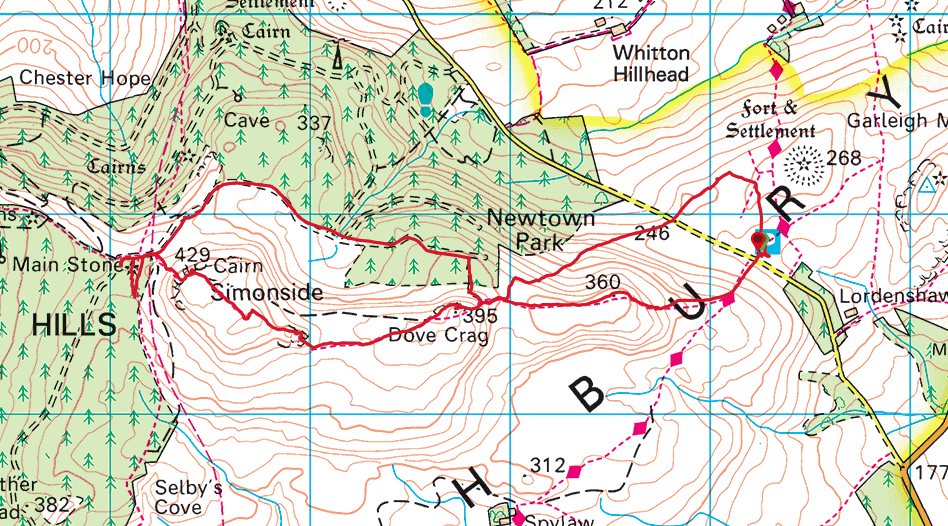
This was a good few weeks ago now, so I thought a brief ‘photo report’ might be the order of the day. This was one of several walks closer to home during lockdown, before we were able to head to the bigger hills. I’m embarrassed to say this was my first time in the Simonside Hills, but as I’m sure is the case for many of us, it was good to discover beauty spots almost on the doorstep.

It may be of interest to others that the tree felling shown in one of the photos below, just as we had descended from Simonside, meant the path marked on the OS map heading south at NZ 021 987 (and so the path we hoped to use to make the walk a larger circular, meeting St Oswald’s Way) was non existent, and the ground very difficult to negotiate. In the end we returned to the good track and went back in a figure of eight.

Do take time, when back at Lordenshaw car park, to investigate the cup and ring marked rocks in the area. This part of the world is steeped in ancient history, and they are bound to set the imagination going…

Simonside

Simonside

Simonside

Simonside

Simonside

Simonside

Simonside

Murton Pike, Murton Fell & High Cup Nick

  • Date walked: 6th June 2020
  • OS Map: OL19 – Howgill Fells & Upper Eden Valley
  • Start/finish point: NY 729 219
  • Distance: 17km
  • Elevation Gain: 619m
  • Hills climbed: Murton Pike (594m), Murton Fell (675m)

Murton Fell & High Cup Nick

High Cup Nick is one of those places I kept on reading about, hearing about, tapping with my finger on the OS map and wondering about. The three red pins marking the fells which sit within the Warcop firing ranges have also been teasing me. They don’t look exciting, they seem dangerous, they need doing – even if only the once. Lots of plotting, more optimistic forecasts, and the prospect of another walk with my good pal Laura, led to a decision to climb Murton Pike, Murton Fell, head around to High Cup Nick, then either descend the boulders into the valley, or else return via one of the high paths.

And while we’re on, let’s try a bit more of this trail running lark.

We arrived at Murton late morning, after driving through the ranges and passing bits and bobs of millitary paraphernalia. There’s parking for a good few cars, and as soon as you leave the car you’re on the good track that leads steadily up towards Murton Pike. The wind was picking up, and by the time we arrived at the trig point after a steep little climb, it was actually difficult to stand up. After admiring the brooding sky, we did an about turn and ran back down the hill until we rejoined the track that would lead us in the direction of Murton Fell, the Hewitt we’d decided to bag today.

Mell Fell and Roman Fell, from Murton Pike

Murton Pike

I say we, actually it was just me. Laura stayed with the main track and we agreed to meet in a little while at the head of Trundale Gill. Unless you’re in the business of bagging summits, I’ve learned that not all hills appeal to all people. Murton Pike looked and felt like a dramatic little hill, it appeals to anybody out on a walk. The prospect of striking out across the pathless moor, going ‘just as far as the danger signs then turning left’ on a mission to locate a somewhat featureless summit strikes some as lunacy.

The loneliness of the Hewitt bagger.

Danger ❗️

Summit plateau of Murton Fell

I will say that I actually found the summit plateau of Murton Fell attractive, and with a spring in my step I set about jogging again, making light work of the boggy ground and skipping my way down to the rendezvous point. Reacquainted with my pal, we followed the path up the hillside and emerged above Middle Tongue. We caught glimpses of the huge valley beneath us, and of the escarpment opposite, but the jaw-dropping spectacle of High Cup Nick really did save itself until we were actually at the, well, Nick. Words failed me. I’d been missing out, and could have sat there all day admiring the view.

High Cup Nick

High Cup Nick

We explored the steep boulder field that takes you from the Nick to the valley floor, but decided it might be slow going, when today was all about travelling light and trotting around in tights. And so we decided to take the path above the same side of the escarpment we had arrived on, stopping frequently to admire the views, watch streams disappear over the edge, and get slightly nervous that we might do the same.

High Cup Nick

High Cup Nick

High Cup Nick

Boulder field, High Cup Nick

Descending Middle Tongue made for easy walking/jogging, and we were surrounded by bog cotton as almost as far as the eye could see. Murton Pike looked still more dramatic from this side, and eventually we dropped down to the farm at Harbour Flatt. We somehow missed the footpath marked on the map, and so just continued to the minor road and followed it back to the car park at Murton. High Cup Nick was spectacular, this part of the Northern Pennines was spectacular, trying some running instead of walking was, if not spectacular, fun.

The sight of me in leggings was neither spectacular nor pleasant. And for that, and to those walkers also enjoying the stunning landscape that day, I apologise most sincerely.

Bog Cotton

Escaping Lockdown – Wild Boar Fell & Swarth Fell

  • Date walked: 30th May 2020
  • OS Map: OL19 – Howgill Fells & Upper Eden Valley
  • Start/finish point: NY 783 005
  • Distance: 16.7km
  • Elevation Gain: 618m
  • Hills Climbed: Wild Boar Fell (708m), Wild Boar Fell East Top (707m), Swarth Fell (681m), Swarth Fell Pike (651m)

Mallerstang Common

After exhausting just about every local footpath, and with the lockdown restrictions gradually easing, I felt it was time to dig the OS maps out, grab my Nuttall guide and make some Hewitt plans. My good friend Laura had agreed to join me for a socially distanced walk, and I felt I owed her something scenic after the misty, rainy baptism of fire on Mungrisdale Common last time we went a-Hewitting. We decided to ‘just touch’ the northern edge of the Yorkshire Dales (still feeling a little naughty going to a National Park at all), and so a plan was set on a gloriously sunny morning to head down to Outhgill, and tackle Wild Boar Fell.

There’s a small parking place at ‘The Thrang’ with room for about half a dozen cars, and from there we followed the footpath through the fields on the other side of the road, gradually working our way under the Settle-Carlisle railway line and on to the fairly steep lower slopes of our first objective, The Nab. The conditions were crystal clear and the sun was beating down on us, but with just enough breeze to keep everything comfortable. I felt I could relax a little, confident this was not going to Mungrisdale 2.0.

Wild Boar Fell & Swarth Fell

Arriving at High Dolphinsty, we left the Pennine Bridleway (not before subjecting Laura to a panoramic lecture – yes, she knows which ones are the Howgills; yes, she knows I slept on that hill…I bore myself sometimes) and followed the path up the ridge towards The Nab, which is a fabulous viewpoint. I love the distinctive profile of hills such as this – all Pen-y-ghent-style steep edges and magnificent views, backed by fairly flat tops and easy ‘back door’ routes. It reminded of the Brecon Beacons, too, and made me wish I knew the first thing about geology.

Wild Boar Fell & Swarth Fell

We left The Nab and made our way across the grassy plateau to the actual summit of Wild Boar Fell, with its renovated trig pillar and wind shelter. More fantastic views, and more lectures. And I wonder why I do most of my walking alone. Returning to the dramatic edge along from The Nab, we visited the cairns between Yoadcomb Scar and High White Scar, chatting, as so many walkers surely do, about the prevalence of such cairns on these hills. I decided I like the Nine Standards kind of tale, imagining these cairns being placed strategically to give the impression of soldiers and lookouts preparing to repel invaders. Certainly, we kept looking at what we thought were people on other hills, only to discover they were cairns. I went into storyteller mode and found myself conjuring up images of hill watches guarding Pendragon Castle in the valley below. I suspect Laura was tempted to push me over the cliff edge.

Wild Boar Fell & Swarth Fell

Wild Boar Fell & Swarth Fell

Wild Boar Fell & Swarth Fell

We walked around the edge of ‘The Band’ and then dropped down the hillside, past a pretty little tarn, then straight back up the next hillside to reach the second Hewitt of the day, Swarth Fell. The view from the summit cairn back across to Wild Boar Fell was spectacular. The wind had really picked up now, which was pleasant on the mild sun burn, but not ideal for sitting down and cracking open the Babybels, so we continued a short way and dropped down slightly to the cairn at Swarth Fell Pike. Slightly sheltered, we took a break and admired the views.

Wild Boar Fell & Swarth Fell

It was now time to head down into the valley, and though not marked as a path as such, we simply followed the boundary line on the map until we arrived at the minor road near Aisgill Moor Cottages. Pausing frequently to look back at the hills we had climbed, we crossed the railway bridge and followed a series of footpaths back along Mallerstang Common. The map reads like the most fascinating history book, and the imagination goes into overdrive: Helgill Force, Slade Edge, Hanging Lund. I kept my mouth shut on this side of the valley, however. No more historical lectures.

Wild Boar Fell & Swarth Fell

We finally left the hillside paths at Elmgill Farm, and we walked along the road for the last few hundred metres or so, back to the car. Once again, the views of the day’s hills were fantastic. Back at The Thrang, we took our boots off and bathed our feet in the icy stream that runs under the road and down into the valley, before reluctantly leaving Mallerstang and heading home. That wasn’t quite it, though. We paused at Outhgill to have a look at the memorial to the workers who died constructing this stretch of the iconic Settle-Carlisle railway, and also to take a look at the replica ‘Jew Stone’. Anybody unfamiliar with the story behind the stone should do a little digging – but far be it from me to lecture you.

Wild Boar Fell & Swarth Fell

Bolt’s Law & Horseshoe Hill

  • Date walked: 21st May 2020
  • OS Map: Explorer 307 – Consett & Derwent Reservoir
  • Start/finish point: NZ 002 430
  • Distance: 17.3km
  • Elevation Gain: 370m
  • Hills climbed: Bolt’s Law (540m), Horseshoe Hill (519m)

Bolt's Law & Horseshoe Hill

While the glorious weather remained and restrictions continued to ease, it was off back to Weardale with a plan to complete the Durham Deweys – I had Bolt’s Law and Horseshoe Hill still to climb. We parked at the end of the Waskerley Way, near Dursands Quarry, and followed the bridleway to the west for a short time – marked Wilkinson’s Cut on the map. We’d planned a fairly lengthy circular rather than a there-and-back walk, so we took the feint path down Whiteley Rigg until we met Stanhope Burn. Losing height did of course mean that we had to plod back up the other side, and recent heather burnings meant the path wasn’t clear, but luckily you can’t really get lost and so we stomped straight up the hillside until we met the good track on Cot Hill (another quarry remnant, I think). From here the walking was easy, and we could enjoy the views over Stanhope Common towards Bolt’s Law.

Stanhope Common

After passing an impressive shooting hut, the track winds its way around Long Law, before joining the Boltslaw Incline: yet another remnant of the area’s industrial past, taking the form of a railway bed straight up the hillside. Once at the top, you’re greeted by interesting ruins of the old engine house and workers’ shelters. I find this kind of industrial architecture fascinating, and it serves as a reminder that these hills were once teeming with human life and industry. Today, however, I hardly saw a soul and could have heard a pin drop. Well, when the breeze let up, anyway.

Mining remnants

Continuing along past the ruins, the track levels out and ultimately veers right, leading back to the bridleway we started on. So it took a little detour over more burned heather to reach the summit of Bolt’s Law. For such a modest hill, the views were fantastic and we took a lunch break at the currick (the trig point offers less impressive views), enjoying views all the way to Cross Fell and beyond. Stunning clear conditions lately!

Bolt's Law

We left Bolt’s Law with some reluctance, and headed down over the heather to rejoin the track – making use of the scorched/clear ground to avoid disturbing nesting birds. It was a straightforward wander along past Dead Friars, and after leaving the track we made our way to the minor road and up the modest slope to reach the summit of the next Dewey, Horseshoe Hill. A much less impressive hill, complete with masts in a fenced compound, slightly boggier ground, but still some pleasant views from the trig.

Looking towards Horseshoe Hill

After a brief rest, we took a pretty straight line down to rejoin the original track, rather than continue across the soft ground and on to the road again. From here it was a lazy stroll all the way back to the car park, stopping now and then to enjoy the views across Stanhope Common. It’s an interesting circular, in that you can almost see the entire route open up before you no matter where you are (views only masked when you’re on the Boltslaw Incline), and it felt great to be out for another substantial walk. If this continues, it might be time to cast my eyes a little further, to some Hewitts…