Haydon Fell (In the Footsteps of John Martin)

  • Date walked: 16th August 2020
  • OS Map: Landranger 87 – Hexham & Haltwhistle
  • Start/finish point: NY 842 645 (Haydon Bridge Railway Station)
  • Distance: 8km
  • Elevation Gain: 219m
  • Hills Climbed: Haydon Fell (246m)

When circumstances and a certain lockdown have conspired to keep me away from the mountains, I’ve spent time investigating local walks and bagging the many modest hills nearer to home. A glance at the ‘show all hills’ option on hill-bagging.co.uk reveals a host of Tumps and smaller mounds, and Haydon Fell had been on my list for a while – the one remaining hill in the Tyne Valley my boots were yet to come into contact with.

And so one afternoon I found myself hopping off the Newcastle-Carlisle train at Haydon Bridge, from where I headed straight up to the public footpath to The Tofts. This right of way is dead straight, up the steep little hillside where views soon open up south across the Tyne Valley. After a short and stiff pull up to the farm, I took a moment at the finger post and first noticed a little sign announcing this was part of the ‘John Martin Heritage Trail’.

Haydon Fell
Finger post announcing the John Martin Heritage Trail

I’ve been a fan of the work of Romantic painter John Martin (1789-1854) for many years, but I’m ashamed to say I’ve never taken time to research the man himself, so while I knew he hailed from the north east I didn’t know he was born in the tiny village of Old Haydon. This master of the epic biblical scene spent his childhood around Haydon Bridge, and attended Sunday School at Haydon Old Church, where today’s walk would eventually take me.

The Destruction of Sodom and Gomorrah (John Martin)
The Destruction of Sodom & Gomorrah (1852)

Turns out the Heritage Trail is in two parts, with section one running for just two miles from Haydon Bridge to the aforementioned Old Haydon, and the second section being a ten-mile walk to the south of Haydon Bridge, following in the footsteps of a young Martin. Definitely worth a return to follow the whole trail, and more information can be found here.

From The Tofts there was now a stretch of road walking, gradually uphill to Westley Bank, and on to a crossroads, where another finger post ushered me over a stile and onto a public footpath towards the summit of Haydon Fell. The ground here was more tussocky heath, and the right of way took me on diagonal straight across the fields to another stile in the wall. I passed the remains of some concrete buildings, and wondered what they were. A little research suggests they are the remains of WW2 watch posts, and with the good views back across Tyne Valley, I can see why.

Haydon Fell
On the way to Haydon Fell
Haydon Fell
Looking back across the Tyne Valley

The summit of Haydon Fell is unremarkable in itself, simply the highest point in a large field of sheep and cattle. The presence of a huge bull was a little disconcerting, but he seemed much more interested in his harem than in me, so I gained the summit with a little help from the OS Maps app, and then hastily made for the trigpoint further away across the field. The views east from the trig were pleasant, and it was well worth taking a little break to admire the vista. From the trigpoint I joined a rough farm track towards the minor road, pausing to wonder at yet another interesting building, whose purpose I have no idea about.

Haydon Fell
The trigpoint on Haydon Fell
Haydon Fell
The mystery building

The pleasant walk along the minor road (fortunately devoid of any traffic) took me downhill to West Haydon Farm, then zigzagged down to Page Croft, where a bench offers excellent views back down to Haydon Bridge itself. It was here that the John Martin Heritage Trail raised its head again, and I took the short detour from Page Croft across the hillside to Haydon Old Church (marked simply as a cross on the OS map). This was a beautiful little find! An information board explained a little about this son of Haydon Bridge, and revealed that the simple little church (sadly locked, doubtless due to Coronavirus) was built in the 12th century, and was where the young John Martin attended Sunday school, and twice-daily services – little wonder biblical themes formed so much of his output! The austere building sits in a beautiful little churchyard, and is well worth taking the time to explore.

Haydon Fell
Haydon Old Church
Haydon Fell
The view from Page Croft

Retracing my steps across the field to Page Croft, it was now quite steeply downhill on the minor road again, until I passed under the railway line and emerged on a pretty riverside path leading into Haydon Bridge. The old bridge takes you straight across the Tyne, and quite conveniently leads to the Anchor Hotel, where I decided it would be rude not to take a drink. From here it was a short hop back across the river to the railway station. All in all the walk took just two leisurely hours, and is fairly easy, for all the surprising amount of ascent and descent. Next stop, the John Martin Heritage Trail proper.

Haydon Bridge
Haydon Bridge

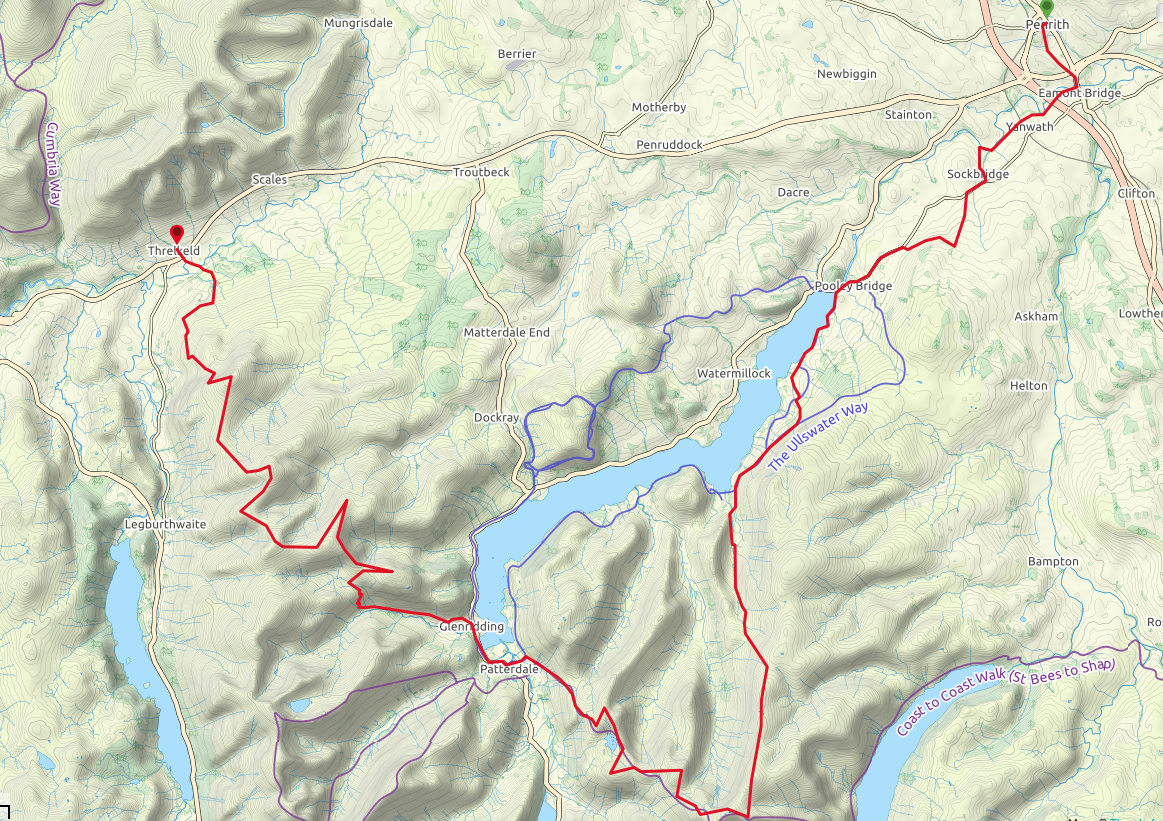
Penrith to Threlkeld, by way of some Elusive Fells

  • Date walked: 24/25th July 2020
  • OS Map: Explorer OL5 – The English Lakes: North-Eastern Area
  • Start/finish point: NY 511 299/NY 322 254
  • Distance: 55km
  • Elevation Gain: 2500m
  • Hills Climbed: High Seat (802m), Kidsty Pike (780m), Rampsgill Head (792m), The Knott (739m), Rest Dodd (696m), Brock Crags (561m), Angletarn Pikes (567m), Sheffield Pike (675m), Hart Side (756m), Stybarrow Dodd (843m), Watson’s Dodd (789m), Great Dodd (857m), Clough Head (726m)

Lakes 1

I’m a fan of coming up with long (perhaps idiosyncratic) walks, joining up hills that I have either missed on previous trips, or would perhaps be a little awkward for me to get to generally. It also makes me feel like I’ve ‘had my money’s worth’ so to speak, given that it takes so long for me to get places on public transport.

And so it was that I set off from Penrith with a plan to walk some of the High Street Roman road (or at least as near to it as you can in the 21st century) and then head off somewhere near High Raise and do a few of the Far Eastern Fells. I strode out of Penrith with a spring in my step, following footpaths through farm fields, the fells teasing me on the horizon. After a while, it became road walking, and I half planned to walk up to Celleron then up on towards ‘The Cockpit’ and on to the fells, some of which I had walked before. In fact, I got to Celleron then suddenly had a change of heart – why not drop down into Pooley Bridge, then walk some of the Ullswater Way? I could always hit the fells somewhere above Howtown.

And so that is how I found myself wandering, one early summer evening, along the path above Ullswater, happy as a pig in muck.

Penrith to Threlkeld

Penrith to Threlkeld

Once past Howtown, I entered Fusedale for the first time – and what a glorious valley! The good path took me gradually along Fusedale Beck and then gradually climbed, and climbed, and climbed, emerging on Wether Hill – hey presto, I was back on the Roman Road. The sun was getting lower in the sky, and up a height the temperature dropped substantially. My mind turned to a bed for the night, but not before bagging Kidsty Pike, Rampsgill Head, and the rather shapely Knott.

Penrith to Threlkeld

Penrith to Threlkeld

Descending The Knott, I found a lovely little flat area overlooking Rest Dodd, and caught sight of several deer. Tent up, perfect spot. Throughout the night the deer came close to the tent and made the most terrifying noises – who’d have thought Bambi would sound like something from a horror film? Very early the next morning I breakfasted in the rain then tackled Rest Dodd head-on, before dropping down towards Brock Crags, along by Angle Tarn, then somewhat awkwardly up to Angletarn Pikes and its list of summits.

As a side note, I was delighted at my previous night’s pitch high up on Knott, and counted no fewer than 17 tents dotted around Angle Tarn. I also counted no fewer than 6 bum cheeks going about their morning movements by the tarn, and found myself feeling a little angry at my fellow man. Or perhaps just bitter that I have braved all manner of uncomfortable conditions in the hills, attending to business far away from my tent, far from paths, digging little holes. At Angletarn-by-the-sea they were only a burger van away from being a resort. Anyway, onwards.

Penrith to Threlkeld

Penrith to Threlkeld

Penrith to Threlkeld

Penrith to Threlkeld

I say onwards, I came across another pair of cheeks at the Boredale Hause ‘junction’, tutted as the cheeks retreated through the tent flaps, then made my way down to Glenridding. Time to adjust myself, attend to aching feet, get rid of rubbish (in a bin, fancy that), before making my way up to the Greenside Road and along the busy path we all know so well.

Penrith to Threlkeld

I stopped to watch the lines of people snake their way up towards Helvellyn, and then left the path to head up to my own private fells, up Stang End and through the interesting remnants of mining works, to make my way to Sheffield Pike. Back down to the path, and then steeply up Glencoyne Head, I was off across to the rather inconveniently situated Hart Side, when the mist suddenly rolled-in and the landscape looked more like it usually does when I’m in the hills.

Penrith to Threlkeld

Penrith to Threlkeld

Penrith to Threlkeld

Next on to the Dodds. The mist cleared every now and then to give me little glimpses of Thirlmere, and by the time I arrived at Watson’s Dodd (an underrated fell in my humble opinion…) the conditions were excellent. I lingered at Watson’s Dodd, and not just because of the name.

Penrith to Threlkeld

Penrith to Threlkeld

The rest of the walk was straightforward, gentle walking – Great Dodd, Calfhow Pike, then straight up the (wet) side of Clough Head. This latter fell has teased me so many times when I’ve travelled by bus into Keswick, it felt great to have conquered it at long last. But it soon conquered me, because the steep descent down the screes made the ending to the walk rather more dramatic and telling on the knees than I would have liked. Great views, though.

And so I snaked my way down to Threlkeld, and had a pint while waiting for my bus, chuffed that I could now tick off a whole bunch of beautiful fells. Fells that have been teasing me for months. Cheers!

Penrith to Threlkeld

Penrith to Threlkeld

Seathwaite Fell & Allen Crags

  • Date walked: 5th July 2020
  • OS Map: Explorer OL4 – The Lake District: North-Western Area/OL5 – The Lake District: South-Western Area
  • Start/finish point: NY 235 121
  • Distance: 14.5km
  • Elevation Gain: 743m
  • Hills Climbed: Seathwaite Fell (632m), Allen Crags (785m)

Seathwaite Fell

This was intended to be walk 5.4 in my Nuttall guide, with Glaramara being the main event, but there was a question mark over the whole walk from the moment we left Gateshead on a wet Sunday morning. Forecasts were ‘interesting’ and we knew the wettest place in England would be, well, pretty wet, but we thought it was worth a look anyway.

How very wet it was. And windy. And pretty cold. And grey. We were drowned rats before we even left Seathwaite Farm. But we plodded onwards. As did several other parties, one of them a pair of young walkers who were planning to climb Scafell Pike. We pointed them in the right direction (or at least a direction) and started the walk up to the very pretty Stockley Bridge. We were chatting about Wainwright bagging as we walked in the driving rain, and the conversation turned to one Paul Tierney, the guy who ran all 214 Wainwrights last year in a record six days or other. Just then, a group of damp fell runners passed us at a little ford. “That’s only Paul Tierney!” I exclaimed. Mr Tierney didn’t hear me, but did say hello as he jogged on by. I felt oddly chuffed to have seen him, a celebrity of the fells, and laughed at what our reaction might have been if AW himself had been around today, and we had bumped into him! Anyway, we crossed the bridge and headed up towards Taylor Force waterfall, all the while scanning Aaron Crags – my guide said to strike out onto the pathless slopes about 300 yards along the path after the plantation ends, but no matter which way I looked at Aaron Crags it seemed like a pretty tough slog up to Wainwright’s summit at 601m. We decided that my (non-peak-obsessed) friend needn’t go through the steep slog, so we arranged to meet at Sprinkling Tarn – she carried on along the path, I headed up to the summit.

Seathwaite Fell and Allen Crags

Seathwaite Fell and Allen Crags

The summit plateau of Seathwaite Fell, with its three tops, reminded me a little of Tarn Crag, and I felt oddly at home already among the knobbly mounds and pretty little bodies of water. The weather conditions were pretty rough, and cloud cover meant the views form the true summit cairn were limited, but I decided I like this fell and it was a shame that an inability to stand up in the wind mean I couldn’t hang around. Soon I dropped down to Sprinkling Tarn, and once reacquainted with my pal, we headed on up the path.

Seathwaite Fell and Allen Crags

Seathwaite Fell and Allen Crags

Seathwaite Fell and Allen Crags

We bumped into our two young friends from the start of the walk, who had climbed Ruddy Gill and got as far as the shelter under Broad End, before calling it a day because of weather and visibility. They also thought they were at Sty Head, and were rather confused, so we spent a while chatting in the rain and sent them back off the way we had come (or at least the way my friend had come) and said our goodbyes. Lovely lads, on their first lakeland walk, and it reminded me of my own baptism(s) of fire in Scotland, soaked to the skin, and wondering what on earth I was doing. I hoped today didn’t put them off, and suggested a few walks and small fells they might consider on the way back home.

But soon, we found ourselves in a similar position to the lads. It had gone rather dark, other walkers seemed to have evaporated, and as we plodded up to Allen Crags, we were treated to hail and stinging faces. Do we continue to Glaramara? Or do we drop down Ruddy Gill and agree that discretion is the better part of valour? We opted for the latter, and reluctantly retraced our steps and dropped down to follow the Ruddy Gill path all the way back to Seathwaite.

Seathwaite Fell and Allen Crags

This was to be just the second time in 135 Wainwrights that I had been defeated (or sternly discouraged…) by weather conditions, and I also knew it wasn’t right to force my pal to plod on when they had come for a walk rather than an expedition.  I found I had to have a word with myself on the way down Ruddy Gill, what on earth was I feeling bad about? A glorious walk in dramatic weather, in one of the most beautiful areas of the country, and somehow not managing to tick all the planned summit boxes made me feel disappointed?! We laughed at the delicious futility of peak bagging, made a few remarks about not seeing the wood for the trees, and the rest of today’s walk was one of two soaked pals, in good spirits, taking what felt like the longest path in Lakeland, admiring views and celebrating that we couldn’t get any more wet.

It was something of a relief when we reached the car at Seathwaite, but it had been a cracking walk. Just not quite walk 5.4.

Oh, and despite what I said above, Glaramara – I’m coming for you…

Seathwaite Fell and Allen Crags

Murton Pike, Murton Fell & High Cup Nick

  • Date walked: 6th June 2020
  • OS Map: OL19 – Howgill Fells & Upper Eden Valley
  • Start/finish point: NY 729 219
  • Distance: 17km
  • Elevation Gain: 619m
  • Hills climbed: Murton Pike (594m), Murton Fell (675m)

Murton Fell & High Cup Nick

High Cup Nick is one of those places I kept on reading about, hearing about, tapping with my finger on the OS map and wondering about. The three red pins marking the fells which sit within the Warcop firing ranges have also been teasing me. They don’t look exciting, they seem dangerous, they need doing – even if only the once. Lots of plotting, more optimistic forecasts, and the prospect of another walk with my good pal Laura, led to a decision to climb Murton Pike, Murton Fell, head around to High Cup Nick, then either descend the boulders into the valley, or else return via one of the high paths.

And while we’re on, let’s try a bit more of this trail running lark.

We arrived at Murton late morning, after driving through the ranges and passing bits and bobs of millitary paraphernalia. There’s parking for a good few cars, and as soon as you leave the car you’re on the good track that leads steadily up towards Murton Pike. The wind was picking up, and by the time we arrived at the trig point after a steep little climb, it was actually difficult to stand up. After admiring the brooding sky, we did an about turn and ran back down the hill until we rejoined the track that would lead us in the direction of Murton Fell, the Hewitt we’d decided to bag today.

Mell Fell and Roman Fell, from Murton Pike

Murton Pike

I say we, actually it was just me. Laura stayed with the main track and we agreed to meet in a little while at the head of Trundale Gill. Unless you’re in the business of bagging summits, I’ve learned that not all hills appeal to all people. Murton Pike looked and felt like a dramatic little hill, it appeals to anybody out on a walk. The prospect of striking out across the pathless moor, going ‘just as far as the danger signs then turning left’ on a mission to locate a somewhat featureless summit strikes some as lunacy.

The loneliness of the Hewitt bagger.

Danger ❗️

Summit plateau of Murton Fell

I will say that I actually found the summit plateau of Murton Fell attractive, and with a spring in my step I set about jogging again, making light work of the boggy ground and skipping my way down to the rendezvous point. Reacquainted with my pal, we followed the path up the hillside and emerged above Middle Tongue. We caught glimpses of the huge valley beneath us, and of the escarpment opposite, but the jaw-dropping spectacle of High Cup Nick really did save itself until we were actually at the, well, Nick. Words failed me. I’d been missing out, and could have sat there all day admiring the view.

High Cup Nick

High Cup Nick

We explored the steep boulder field that takes you from the Nick to the valley floor, but decided it might be slow going, when today was all about travelling light and trotting around in tights. And so we decided to take the path above the same side of the escarpment we had arrived on, stopping frequently to admire the views, watch streams disappear over the edge, and get slightly nervous that we might do the same.

High Cup Nick

High Cup Nick

High Cup Nick

Boulder field, High Cup Nick

Descending Middle Tongue made for easy walking/jogging, and we were surrounded by bog cotton as almost as far as the eye could see. Murton Pike looked still more dramatic from this side, and eventually we dropped down to the farm at Harbour Flatt. We somehow missed the footpath marked on the map, and so just continued to the minor road and followed it back to the car park at Murton. High Cup Nick was spectacular, this part of the Northern Pennines was spectacular, trying some running instead of walking was, if not spectacular, fun.

The sight of me in leggings was neither spectacular nor pleasant. And for that, and to those walkers also enjoying the stunning landscape that day, I apologise most sincerely.

Bog Cotton

Escaping Lockdown – Wild Boar Fell & Swarth Fell

  • Date walked: 30th May 2020
  • OS Map: OL19 – Howgill Fells & Upper Eden Valley
  • Start/finish point: NY 783 005
  • Distance: 16.7km
  • Elevation Gain: 618m
  • Hills Climbed: Wild Boar Fell (708m), Wild Boar Fell East Top (707m), Swarth Fell (681m), Swarth Fell Pike (651m)

Mallerstang Common

After exhausting just about every local footpath, and with the lockdown restrictions gradually easing, I felt it was time to dig the OS maps out, grab my Nuttall guide and make some Hewitt plans. My good friend Laura had agreed to join me for a socially distanced walk, and I felt I owed her something scenic after the misty, rainy baptism of fire on Mungrisdale Common last time we went a-Hewitting. We decided to ‘just touch’ the northern edge of the Yorkshire Dales (still feeling a little naughty going to a National Park at all), and so a plan was set on a gloriously sunny morning to head down to Outhgill, and tackle Wild Boar Fell.

There’s a small parking place at ‘The Thrang’ with room for about half a dozen cars, and from there we followed the footpath through the fields on the other side of the road, gradually working our way under the Settle-Carlisle railway line and on to the fairly steep lower slopes of our first objective, The Nab. The conditions were crystal clear and the sun was beating down on us, but with just enough breeze to keep everything comfortable. I felt I could relax a little, confident this was not going to Mungrisdale 2.0.

Wild Boar Fell & Swarth Fell

Arriving at High Dolphinsty, we left the Pennine Bridleway (not before subjecting Laura to a panoramic lecture – yes, she knows which ones are the Howgills; yes, she knows I slept on that hill…I bore myself sometimes) and followed the path up the ridge towards The Nab, which is a fabulous viewpoint. I love the distinctive profile of hills such as this – all Pen-y-ghent-style steep edges and magnificent views, backed by fairly flat tops and easy ‘back door’ routes. It reminded of the Brecon Beacons, too, and made me wish I knew the first thing about geology.

Wild Boar Fell & Swarth Fell

We left The Nab and made our way across the grassy plateau to the actual summit of Wild Boar Fell, with its renovated trig pillar and wind shelter. More fantastic views, and more lectures. And I wonder why I do most of my walking alone. Returning to the dramatic edge along from The Nab, we visited the cairns between Yoadcomb Scar and High White Scar, chatting, as so many walkers surely do, about the prevalence of such cairns on these hills. I decided I like the Nine Standards kind of tale, imagining these cairns being placed strategically to give the impression of soldiers and lookouts preparing to repel invaders. Certainly, we kept looking at what we thought were people on other hills, only to discover they were cairns. I went into storyteller mode and found myself conjuring up images of hill watches guarding Pendragon Castle in the valley below. I suspect Laura was tempted to push me over the cliff edge.

Wild Boar Fell & Swarth Fell

Wild Boar Fell & Swarth Fell

Wild Boar Fell & Swarth Fell

We walked around the edge of ‘The Band’ and then dropped down the hillside, past a pretty little tarn, then straight back up the next hillside to reach the second Hewitt of the day, Swarth Fell. The view from the summit cairn back across to Wild Boar Fell was spectacular. The wind had really picked up now, which was pleasant on the mild sun burn, but not ideal for sitting down and cracking open the Babybels, so we continued a short way and dropped down slightly to the cairn at Swarth Fell Pike. Slightly sheltered, we took a break and admired the views.

Wild Boar Fell & Swarth Fell

It was now time to head down into the valley, and though not marked as a path as such, we simply followed the boundary line on the map until we arrived at the minor road near Aisgill Moor Cottages. Pausing frequently to look back at the hills we had climbed, we crossed the railway bridge and followed a series of footpaths back along Mallerstang Common. The map reads like the most fascinating history book, and the imagination goes into overdrive: Helgill Force, Slade Edge, Hanging Lund. I kept my mouth shut on this side of the valley, however. No more historical lectures.

Wild Boar Fell & Swarth Fell

We finally left the hillside paths at Elmgill Farm, and we walked along the road for the last few hundred metres or so, back to the car. Once again, the views of the day’s hills were fantastic. Back at The Thrang, we took our boots off and bathed our feet in the icy stream that runs under the road and down into the valley, before reluctantly leaving Mallerstang and heading home. That wasn’t quite it, though. We paused at Outhgill to have a look at the memorial to the workers who died constructing this stretch of the iconic Settle-Carlisle railway, and also to take a look at the replica ‘Jew Stone’. Anybody unfamiliar with the story behind the stone should do a little digging – but far be it from me to lecture you.

Wild Boar Fell & Swarth Fell

Bolt’s Law & Horseshoe Hill

  • Date walked: 21st May 2020
  • OS Map: Explorer 307 – Consett & Derwent Reservoir
  • Start/finish point: NZ 002 430
  • Distance: 17.3km
  • Elevation Gain: 370m
  • Hills climbed: Bolt’s Law (540m), Horseshoe Hill (519m)

Bolt's Law & Horseshoe Hill

While the glorious weather remained and restrictions continued to ease, it was off back to Weardale with a plan to complete the Durham Deweys – I had Bolt’s Law and Horseshoe Hill still to climb. We parked at the end of the Waskerley Way, near Dursands Quarry, and followed the bridleway to the west for a short time – marked Wilkinson’s Cut on the map. We’d planned a fairly lengthy circular rather than a there-and-back walk, so we took the feint path down Whiteley Rigg until we met Stanhope Burn. Losing height did of course mean that we had to plod back up the other side, and recent heather burnings meant the path wasn’t clear, but luckily you can’t really get lost and so we stomped straight up the hillside until we met the good track on Cot Hill (another quarry remnant, I think). From here the walking was easy, and we could enjoy the views over Stanhope Common towards Bolt’s Law.

Stanhope Common

After passing an impressive shooting hut, the track winds its way around Long Law, before joining the Boltslaw Incline: yet another remnant of the area’s industrial past, taking the form of a railway bed straight up the hillside. Once at the top, you’re greeted by interesting ruins of the old engine house and workers’ shelters. I find this kind of industrial architecture fascinating, and it serves as a reminder that these hills were once teeming with human life and industry. Today, however, I hardly saw a soul and could have heard a pin drop. Well, when the breeze let up, anyway.

Mining remnants

Continuing along past the ruins, the track levels out and ultimately veers right, leading back to the bridleway we started on. So it took a little detour over more burned heather to reach the summit of Bolt’s Law. For such a modest hill, the views were fantastic and we took a lunch break at the currick (the trig point offers less impressive views), enjoying views all the way to Cross Fell and beyond. Stunning clear conditions lately!

Bolt's Law

We left Bolt’s Law with some reluctance, and headed down over the heather to rejoin the track – making use of the scorched/clear ground to avoid disturbing nesting birds. It was a straightforward wander along past Dead Friars, and after leaving the track we made our way to the minor road and up the modest slope to reach the summit of the next Dewey, Horseshoe Hill. A much less impressive hill, complete with masts in a fenced compound, slightly boggier ground, but still some pleasant views from the trig.

Looking towards Horseshoe Hill

After a brief rest, we took a pretty straight line down to rejoin the original track, rather than continue across the soft ground and on to the road again. From here it was a lazy stroll all the way back to the car park, stopping now and then to enjoy the views across Stanhope Common. It’s an interesting circular, in that you can almost see the entire route open up before you no matter where you are (views only masked when you’re on the Boltslaw Incline), and it felt great to be out for another substantial walk. If this continues, it might be time to cast my eyes a little further, to some Hewitts…

Five Pikes & Hamsterley Common

  • Date walked: 16th May 2020
  • OS Map: OL31 – North Pennines (Teesdale & Weardale)
  • Start/finish point: NY 996 306
  • Distance: 9.75km
  • Elevation gain:408m
  • Hills climbed: Pawlaw Pike (488m), Five Pikes (478m)

Five Pikes & Hamsterley Common

This was the first walk outside of my immediate area in almost two months, and while Weardale is still only a fairly short drive from Gateshead, I still felt like a naughty school boy doing something I oughtn’t to be doing. I reasoned that actually I was less likely to come into contact with people up here than if I went to my local park again, and I was right – I didn’t see another soul all day, but for an estate worker driving along moorland tracks, checking on the shooting huts.

There is a small car parking area at NY 996 306, near Little Eggleshope Beck, and immediately you see the well-constructed paths onto various hillsides, and of course the roads and tracks built for the shooting fraternity. These paths make for easy walking, and so before long I was gaining ascent without really noticing, and heading for the first hill of the day – Pawlaw Pike. Staying local has given me an appreciation of unclassified hills. These modest summits often have interesting names and are all marked on the map, but don’t fit any of the criteria to be hills on tickable lists, or to pique the interest of hillwalkers at large. I find them fascinating, and have enjoyed walking and ticking-off all the hills on my local maps, regardless of their modesty. Pawlaw pike is merely a raised lump on the otherwise featureless moor, but forms an impressive little peak in its own way, and allows wonderful panoramic views of Weardale and Hamsterley Common. Dropping back to the track , I headed on towards Five Pikes, with its trig point at 478m and the well-made stone currick offering views down towards Hamsterley Common.

Currick on Five Pikes

There was a warm wind which just offered enough relief from the sun, and I enjoyed the sound of silence as I plodded ever downwards, towards the interestingly named Meeting of the Grains. I say silence, but I ought to mention the electronic calls of the defensive Lapwings, swooping close-by to make sure I didn’t leave the track and disturb their nests, and of course the disgruntled calls of the ubiquitous Red Grouse, who seem to wait until you’re almost on top of them before they dart out of the heather. Perhaps they want to make sure we know what it feels like to get a shock to the system. The expanse of moorland visible on all sides at first seems fairly featureless, but the more time you spend in the heather, the closer you look at even the smallest of patches of ground, the more you realise how much these landscapes teem with life. There is nothing dull about walking on moorland, and in these weather conditions, where even potentially boggy ground was dry as a bone, it was hard to imagine wanting to be anywhere else.

Pikeston Fell

The Meeting of the Grains is an unexpectedly green, wooded glade tucked away between heathery slopes, and struck me as being a perfect bivvy spot for future visits. Sheltered from the wind, lush and green, and with a pond and a beautiful babbling stream running through it, this little oasis seemed a natural place to stop for lunch. It was with some reluctance that I stood up again 15 minutes later to stomp my way up the heathery hillside and across Hamsterley Common.

Meeting of the Grains

The footpath across the common soon deposits you on the northern edge of Hamsterley Forest, and a stiff and seemingly underused gate grants you access to this vast woodland. I’d not set foot in Hamsterley Forest since I was a child growing up in County Durham – sad to think that it has taken lockdown to get me to explore the place again. A narrow forest path that wouldn’t be out of place in a Grimm fairy tale leads gently though the trees and deeper into the forest, emerging at a forestry track and a sign that warns of a ‘dangerous descent’ ahead, and a ‘stream crossing’. I peered over the edge into the valley in question, and decide that whoever made the sign was perhaps overcautious. a gentle trot down the hillside brought me to the stream, which was fairly dry due to the recent hot weather. And in any case, there were stepping stones. From here I took a sharp right and joined another track, which snaked up the hillside to the area know as Sharnberry Flat. Rabbits darted across the track every now and then, and at one point I thought I saw a deer out of the corner of my eye, but whatever it was, it moved too fast to be sure.

Hamsterley Forest

Sharnberry Flat and my brief foray into Hamsterley Forest eventually gave way to a path high above Sharnberry Gill, where remnants of the area’s mining past were clearly visible. A shaft opening here, a scarred hillside there, the kind of landscape you become very used to in the North Pennines. Sharnberry Gill winds its way back to the car park, or should I say from the car park, given that this home strait was uphill. I stopped near the modern shooting huts to rest by the ice cold stream, before pushing the final few hundred meters to the car park. This first substantial outing since lockdown began was a treat, and the weather could not have been better. A reminder that there is some wonderful walking almost on the doorstep, so long as you don’t mind leaving the tickable hill lists at home once in a while.

Writing about the Great Outdoors

I’ve been meaning to start blogging about my outdoor adventures for some time, but have always stopped short of typing the first few words – how does one know when they have enough experience to share anything meaningful? When does an outdoors newbie cross the line and think of themselves as experienced enough to have something to say? Lockdown has, for all its hellish impact on all our lives, given us a chance to reset and perhaps take stock of the things we do – and so recently I have found myself totting-up my hill bagging tallies, poring over notebooks from long-distance walks, editing photos from the last couple of years of hiking adventures, and I feel perhaps I might just have had enough adventures to be of at least some interest, to someone, somewhere.

The Lake District - Western Fells

It all started in 2016, when grief and ongoing family illnesses made me crave an escape. I was no stranger to travelling, and had spent a lot of time in previous years hopping across Europe on short trips and adventures, but urban adventures no longer felt like the right fit for me, and I felt an inexplicable urge to head to Scotland. I’m glad I did. With some cheap boots on my feet and a lot of cheap gear on my back, I disappeared to Barra in the Outer Hebrides, with no skills, no experience, and even less clue about the fact that August is not necessarily the best time to camp there. I returned to the mainland, and my normal life, a changed man. Since August 2016 the outdoors have been more an obsession than a hobby, and thanks to the likes of Walkhighlands and their incredible hillwalking resources, thanks to the myriad guidebooks and maps out there, thanks to blog posts by other, more seasoned adventurers, I have spent the last 3-and-a-bit years getting out at every opportunity. Next came the Hebridean Way, the island bagging, the wild camping, the fascination with hill bagging, a few more long distance walks. At the time of starting this blog, my hill lists are as follows:

  • 12 Munros
  • 29 Corbetts
  • 28 Grahams
  • 74 Donalds
  • 120 Wainwrights
  • 111 Hewitts
  • 92 Scottish Marilyns
  • A host of other, little hills, often of no less character

And so, sitting on top of this list of hills and exploits, having spend a lot of time either in my tent or bivvy bag staring at the stars, having walked and scrambled in all weathers and at all times of year, I finally decided I can call myself an outdoor enthusiast rather than a newbie walker, and it is time to start typing, at long last.

I hope the blog posts that follow are of interest. Perhaps you’ve walked the same routes, climbed the same hills; maybe I can learn from fellow outdoors people; maybe I’ve met you on the hill already, or our paths might yet cross out there in the wilderness; maybe, just maybe, my posts will be of some interest or inspiration when you’re planning your own adventures and exploits.

Inspiration

Most of my outdoor trips are done using public transport. All of them are done on a budget. It amazes me, when I’m sitting atop a somewhat remote Donald in southern Scotland, that I was able to get there on a string of trains, ever-smaller buses, and a healthy dose of determination. I hope that the theme of ‘getting out there no matter how awkward the place may be to get to’ rings clear in my blog posts, and finally I should make mention of the power of the great outdoors to soothe the soul. Fortunately, the idea of ‘mountains for the mind’ is a popular and well-documented one these days, and so many people I meet have tales to tell about how the great outdoors is good for their mental health, their wellbeing, their soul. My own adventure started out of painful and emotional times, and I have found the great outdoors to be the greatest healer of all.

I hope you enjoy my posts, and perhaps I’ll see you on the hill…