The Red Kite Trail

  • Date walked: 23rd January 2021
  • OS Map: Explorer 307 – Consett & Derwent Reservoir/Explorer 316 – Newcastle upon Tyne
  • Start/finish point: NZ 185 608
  • Distance: 21.73km
  • Elevation gain: 296m

With January being all about staying local, revisiting the paths I’ve walked many times and trying to see them through new eyes, I was beginning to think I’d explored pretty much everything there is to see around Gateshead. Granted there are always occasional rights of way you spot when poring over the OS map, and can’t quite remember if you’ve trodden them or not, but in terms of longer, more ‘interesting’ walks, I was perhaps getting tired. Thank goodness for Viewranger, then. In ‘Outdoors Map’ mode, I’ve noticed that all manner of labelled paths and longer distance walks are shown, some of which don’t appear on the OS map – other than as various green lines. So, we’re au fait with the Tanfield Railway path, we’ve walked the Bowes Railway path a dozen times, we’ve done the large and impressive loop that is the Tyne & Wear Heritage Way – 128km of local underfoot goodness – in both directions. Then there’s the Red Kite Trail.

The what?

Yes, the Red Kite Trail. Perhaps I missed the memo, perhaps everyone has walked it a million times, perhaps I’ve just been blind to the way markers. In my defence, though I’ve lived in Gateshead for eight years, I’ve been walking for only a quarter of that time. Perhaps I’m still young, fresh, and ignorant. Well, certainly not young. Whatever the case, the Red Kite Trail is a delicious circular walk of about 20km taking in a stretch of the popular Derwent Walk, a tantalisingly short foray into the ever more popular Chopwell Wood, before heading up onto some high level (for Gateshead) farmland above Rowlands Gill, eventually dropping back down to your starting point at Winlaton Mill. Of course this is well known for being red kite territory – some 94 of these majestic birds of prey were reintroduced to the Derwent Valley between 2004 and 2009, and they seem to thrive. Many’s the time I’ve glanced up from my map on hearing the kite’s distinctive call, and watched one or two birds glide just above the treetops. They have their own walk, and I decided to explore for myself.

The Red Kite Trail

The walk starts at the wonderfully named Land of Oak & Iron, a local heritage centre with a substantial car park. The centre was, of course, closed due to a certain lockdown, but the car park was open, free, and not gated. This spot is well served by public transport, too: Go North East have all the answers.

This was one of those mild but frosty mornings we’ve had so many of lately, a little crunchy underfoot and the sun shining brightly most of the (short) day. A plethora of way markers served only to make me feel even more ignorant, and took me through a section of the Derwent Walk Country Park, around Kite Hill (the clues really have been there the whole time) and then soon up onto the Derwent Walk itself. This old railway, repurposed as a multi-use path between Swalwell and Consett, is a path I’ve walked many times, and makes for an easy and at times scenic (especially at the viaducts) plod. Number of red kites seen so far: none.

The Red Kite Trail

The Derwent Walk comes to a halt at Rowlands Gill to make way for a road, which must be crossed, but then I was soon back on the path and wandered another couple of kilometres until finally leaving the railway path above Lintzford. Just the A694 to cross now, then the rest of the walk would be all tracks and paths, or else very minor roads free of traffic. A word of caution – emerging at the pretty hamlet of Lintzford onto the road, I missed any way markers that may have been there, and for some reason followed what felt like the natural course of the path to the left, expecting to cross the road further up and head into the obvious woodland. Turns out a few other people made the same mistake (note the spur on the map above!), and after bothering to check the OS map, we found ourselves wandering awkwardly back down to the actual path – directly over the road from the bridge at Lintzford. An all-the-gear-and-no-idea moment, if you like. Anyway, once over the road I was greeted by a gate, a sign, and a path into Chopwell Wood. Number of red kites seen so far: none.

The Red Kite Trail

Chopwell Wood is a delight. 360 hectares of mixed woodland, with plenty of paths and enough ascent to remind you of more dramatic woods further north in Northumberland, it’s a popular spot for walkers, bikers, and apparently, red kites. The Red Kite Trail touches only the eastern edge of the woodland, the track rising steeply at first before levelling out and offering one or two very good viewpoints over the treetops. Atop one such viewpoint sits a wooden sculpture of a red kite – would this be the only red kite I’d see today? Pausing to enjoy the woodland views, and a sandwich, I did hear the mildly aggressive call of several jays, and caught the odd glimpse of light purple plumage in the trees. Number of red kites seen so far: none, unless you count the wooden one.

The Red Kite Trail
The Red Kite Trail

Onwards. Emerging from the woods, and after a short section of walking on a very quiet road, I arrived at Spen Banks. This smaller area of woodland was largely deserted – once out of the popular Derwent valley, it seems only dog walkers bother to explore here. I got the same kind of feeling I get whenever I watch the hordes ascending Helvellyn from my little vantage point at Stang End. I started thinking of the Lake District – something I keep doing during lockdown, and something I have decided is not healthy. Will we ever get to see lakeland again? My mind returned to the muddy path in front of me, and I kept my eyes and ears open for red kites. Soon the Red Kite Trail merged with the Tyne & Wear Heritage Way, so I was walking familiar territory. Then a little detour. Taking the track north, the RK trail heads up to the little village of Barlow, which at about 170m makes for a surprisingly good viewpoint north. This is the edge of kite territory, and after first questioning the detour, I acknowledged NZ 152 606 would be a perfect spot to linger, hopefully. Number of red kites seen so far: none.

The Red Kite Trail

After the Barlow detour, I followed the way markers back down to meet the heritage way once again, and the two trails became one for the rest of today’s walk. This is all farmland walking, with pleasant views south towards the Derwent Valley. Thornley Bank, High Thornley, Low Thornley, you mark your descent as much with etymology as you do with contours. The light was fading now, but still way markers appeared now and then, seemingly to remind me that I must have been blind not to have seen the RK trail when plodding these paths previously. Number of red kites seen: none.

The Red Kite Trail

The home straight. Once over the A694, the path snakes high above the river Derwent, along Winlaton Scar. I can vouch for one or two quite stunning viewpoints looking through the trees across to Gibside and the Liberty Monument, but by now it was dark and it was much more about negotiating patches of ice, mud, or both. The path drops down to the Derwent Walk Country Park, and soon I found myself on the path back to the Land of Oak & Iron. Where earlier in the day it had been all about looking down at water and frosty bullrushes, now it was about ending the day looking up at silhouetted trees, feeling the tinge of sadness I get at the close of every walk, and pausing to appreciate the beauty to be found on my doorstep.

Number of red kites seen: none.

The Red Kite Trail

Hareshaw Linn

  • Date walked: 1st January 2021
  • OS Map: OL42 – Kielder Water & Forest
  • Start/finish point: NY 839 833
  • Distance: 6.97km
  • Elevation gain: 132m

During lockdown I have explored a lot of places in Northumberland, but am ashamed to say I hadn’t heard of Hareshaw Linn until very recently. Perhaps because I try to avoid tourist hotspots where possible, perhaps because there is so much more to the beautiful county of Northumberland than I ever thought. I decided to stride into the New Year with a spring in my step, and headed across to Bellingham on New Year’s Day.

Bellingham is a pretty village in the centre of Northumberland, the River North Tyne running to its south, the military ranges and expansive moorland opening up to its north. There is a free car park at the start of the popular path to Hareshaw Linn waterfall, but for public transport users there is also an excellent public transport service in this part of the world, with buses connecting Hexham and Bellingham at least every couple of hours. However you get there, you soon find yourself on the easy path north out of the village, and that’s exactly where I found myself this crisp New Year morning.

Hareshaw Linn

The good path soon became muddy and icy in quick succession, and gradually gained height above the burn flowing noisily below. Shortly I came to the first of several well-constructed wooden bridges (the first of six, if I recall) that cross the burn as the path winds its way further up what can, by this stage, safely be called a gorge. For a wintery day during lockdown, I was perhaps surprised at the number of other visitors and walkers, but then it was New Year’s Day and of course this is (so I learned later) a beauty spot that features on many ‘must visit’ lists of Northumberland locations.

Hareshaw Linn

Some slippery rock steps negotiated along the way, and one or two small, appetiser, waterfalls encountered, I found myself at a high vantage point with the magnificent Hareshaw Linn revealing itself through the trees ahead. The gentle walk up the gorge had taken about an hour. The roar of the falls was tremendous, and the cliffs on either side of the gorge rose to giddying heights. A pool at the base of the falls completed the idyllic picture (I’m sure in summer this place is heaving with visitors, many of whom will doubtless take a dip), and a series of stone steps led the way down to the waterfall itself.

Hareshaw Linn

With my waterproof coat on, and hood up, I scrambled down to get even closer to the waterfall and enjoyed the odd sense of silence and calm that comes from one of the loudest forces of nature. I could have stood there for hours, but a fairly steady stream of visitors was arriving at the falls and I’m sure they didn’t all want me standing in their photographs.

Hareshaw Linn

Reluctantly, I peeled myself away from the waterfall and headed back up the pretty stone staircase to the path. The return walk is by exactly the same route, and so the whole walk came in at around two hours, allowing for plenty time to admire scenery and eat sandwiches. Hareshaw Linn is a remarkable sight, and such an unexpected surprise given the sprawling moorland that surrounds on almost all sides of the area. I can’t wait to return – in all weathers – to again pay my respects to one of the most impressive and powerful wonders of Northumberland.

Hareshaw Linn

A Windy Wander on Simonside

  • Date walked: 23rd May 2020
  • OS Map: OL42 – Kielder Water & Forest
  • Start/finish point: NZ 052 987
  • Distance: 9.3km
  • Elevation gain: 321m
  • Hills Climbed: Simonside (430m)

Simonside

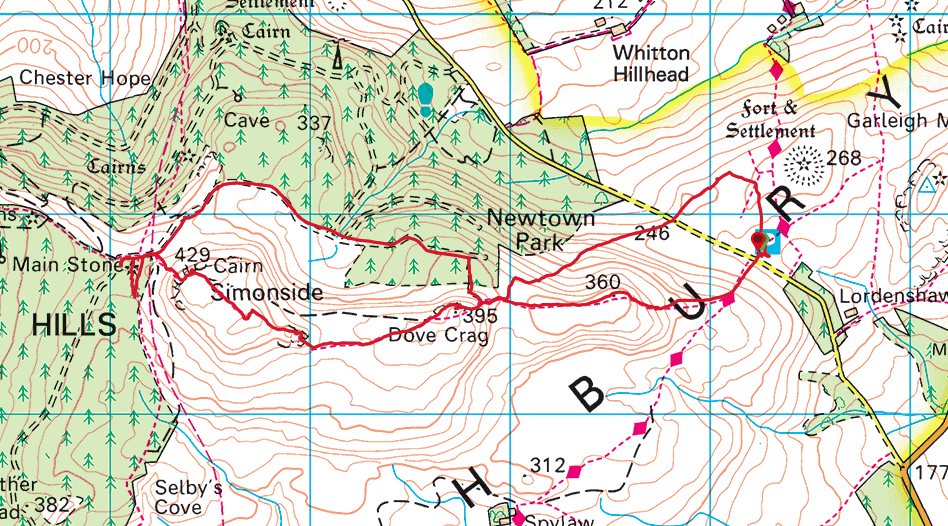
This was a good few weeks ago now, so I thought a brief ‘photo report’ might be the order of the day. This was one of several walks closer to home during lockdown, before we were able to head to the bigger hills. I’m embarrassed to say this was my first time in the Simonside Hills, but as I’m sure is the case for many of us, it was good to discover beauty spots almost on the doorstep.

It may be of interest to others that the tree felling shown in one of the photos below, just as we had descended from Simonside, meant the path marked on the OS map heading south at NZ 021 987 (and so the path we hoped to use to make the walk a larger circular, meeting St Oswald’s Way) was non existent, and the ground very difficult to negotiate. In the end we returned to the good track and went back in a figure of eight.

Do take time, when back at Lordenshaw car park, to investigate the cup and ring marked rocks in the area. This part of the world is steeped in ancient history, and they are bound to set the imagination going…

Simonside

Simonside

Simonside

Simonside

Simonside

Simonside

Simonside

Murton Pike, Murton Fell & High Cup Nick

  • Date walked: 6th June 2020
  • OS Map: OL19 – Howgill Fells & Upper Eden Valley
  • Start/finish point: NY 729 219
  • Distance: 17km
  • Elevation Gain: 619m
  • Hills climbed: Murton Pike (594m), Murton Fell (675m)

Murton Fell & High Cup Nick

High Cup Nick is one of those places I kept on reading about, hearing about, tapping with my finger on the OS map and wondering about. The three red pins marking the fells which sit within the Warcop firing ranges have also been teasing me. They don’t look exciting, they seem dangerous, they need doing – even if only the once. Lots of plotting, more optimistic forecasts, and the prospect of another walk with my good pal Laura, led to a decision to climb Murton Pike, Murton Fell, head around to High Cup Nick, then either descend the boulders into the valley, or else return via one of the high paths.

And while we’re on, let’s try a bit more of this trail running lark.

We arrived at Murton late morning, after driving through the ranges and passing bits and bobs of millitary paraphernalia. There’s parking for a good few cars, and as soon as you leave the car you’re on the good track that leads steadily up towards Murton Pike. The wind was picking up, and by the time we arrived at the trig point after a steep little climb, it was actually difficult to stand up. After admiring the brooding sky, we did an about turn and ran back down the hill until we rejoined the track that would lead us in the direction of Murton Fell, the Hewitt we’d decided to bag today.

Mell Fell and Roman Fell, from Murton Pike

Murton Pike

I say we, actually it was just me. Laura stayed with the main track and we agreed to meet in a little while at the head of Trundale Gill. Unless you’re in the business of bagging summits, I’ve learned that not all hills appeal to all people. Murton Pike looked and felt like a dramatic little hill, it appeals to anybody out on a walk. The prospect of striking out across the pathless moor, going ‘just as far as the danger signs then turning left’ on a mission to locate a somewhat featureless summit strikes some as lunacy.

The loneliness of the Hewitt bagger.

Danger ❗️

Summit plateau of Murton Fell

I will say that I actually found the summit plateau of Murton Fell attractive, and with a spring in my step I set about jogging again, making light work of the boggy ground and skipping my way down to the rendezvous point. Reacquainted with my pal, we followed the path up the hillside and emerged above Middle Tongue. We caught glimpses of the huge valley beneath us, and of the escarpment opposite, but the jaw-dropping spectacle of High Cup Nick really did save itself until we were actually at the, well, Nick. Words failed me. I’d been missing out, and could have sat there all day admiring the view.

High Cup Nick

High Cup Nick

We explored the steep boulder field that takes you from the Nick to the valley floor, but decided it might be slow going, when today was all about travelling light and trotting around in tights. And so we decided to take the path above the same side of the escarpment we had arrived on, stopping frequently to admire the views, watch streams disappear over the edge, and get slightly nervous that we might do the same.

High Cup Nick

High Cup Nick

High Cup Nick

Boulder field, High Cup Nick

Descending Middle Tongue made for easy walking/jogging, and we were surrounded by bog cotton as almost as far as the eye could see. Murton Pike looked still more dramatic from this side, and eventually we dropped down to the farm at Harbour Flatt. We somehow missed the footpath marked on the map, and so just continued to the minor road and followed it back to the car park at Murton. High Cup Nick was spectacular, this part of the Northern Pennines was spectacular, trying some running instead of walking was, if not spectacular, fun.

The sight of me in leggings was neither spectacular nor pleasant. And for that, and to those walkers also enjoying the stunning landscape that day, I apologise most sincerely.

Bog Cotton

Escaping Lockdown – Wild Boar Fell & Swarth Fell

  • Date walked: 30th May 2020
  • OS Map: OL19 – Howgill Fells & Upper Eden Valley
  • Start/finish point: NY 783 005
  • Distance: 16.7km
  • Elevation Gain: 618m
  • Hills Climbed: Wild Boar Fell (708m), Wild Boar Fell East Top (707m), Swarth Fell (681m), Swarth Fell Pike (651m)

Mallerstang Common

After exhausting just about every local footpath, and with the lockdown restrictions gradually easing, I felt it was time to dig the OS maps out, grab my Nuttall guide and make some Hewitt plans. My good friend Laura had agreed to join me for a socially distanced walk, and I felt I owed her something scenic after the misty, rainy baptism of fire on Mungrisdale Common last time we went a-Hewitting. We decided to ‘just touch’ the northern edge of the Yorkshire Dales (still feeling a little naughty going to a National Park at all), and so a plan was set on a gloriously sunny morning to head down to Outhgill, and tackle Wild Boar Fell.

There’s a small parking place at ‘The Thrang’ with room for about half a dozen cars, and from there we followed the footpath through the fields on the other side of the road, gradually working our way under the Settle-Carlisle railway line and on to the fairly steep lower slopes of our first objective, The Nab. The conditions were crystal clear and the sun was beating down on us, but with just enough breeze to keep everything comfortable. I felt I could relax a little, confident this was not going to Mungrisdale 2.0.

Wild Boar Fell & Swarth Fell

Arriving at High Dolphinsty, we left the Pennine Bridleway (not before subjecting Laura to a panoramic lecture – yes, she knows which ones are the Howgills; yes, she knows I slept on that hill…I bore myself sometimes) and followed the path up the ridge towards The Nab, which is a fabulous viewpoint. I love the distinctive profile of hills such as this – all Pen-y-ghent-style steep edges and magnificent views, backed by fairly flat tops and easy ‘back door’ routes. It reminded of the Brecon Beacons, too, and made me wish I knew the first thing about geology.

Wild Boar Fell & Swarth Fell

We left The Nab and made our way across the grassy plateau to the actual summit of Wild Boar Fell, with its renovated trig pillar and wind shelter. More fantastic views, and more lectures. And I wonder why I do most of my walking alone. Returning to the dramatic edge along from The Nab, we visited the cairns between Yoadcomb Scar and High White Scar, chatting, as so many walkers surely do, about the prevalence of such cairns on these hills. I decided I like the Nine Standards kind of tale, imagining these cairns being placed strategically to give the impression of soldiers and lookouts preparing to repel invaders. Certainly, we kept looking at what we thought were people on other hills, only to discover they were cairns. I went into storyteller mode and found myself conjuring up images of hill watches guarding Pendragon Castle in the valley below. I suspect Laura was tempted to push me over the cliff edge.

Wild Boar Fell & Swarth Fell

Wild Boar Fell & Swarth Fell

Wild Boar Fell & Swarth Fell

We walked around the edge of ‘The Band’ and then dropped down the hillside, past a pretty little tarn, then straight back up the next hillside to reach the second Hewitt of the day, Swarth Fell. The view from the summit cairn back across to Wild Boar Fell was spectacular. The wind had really picked up now, which was pleasant on the mild sun burn, but not ideal for sitting down and cracking open the Babybels, so we continued a short way and dropped down slightly to the cairn at Swarth Fell Pike. Slightly sheltered, we took a break and admired the views.

Wild Boar Fell & Swarth Fell

It was now time to head down into the valley, and though not marked as a path as such, we simply followed the boundary line on the map until we arrived at the minor road near Aisgill Moor Cottages. Pausing frequently to look back at the hills we had climbed, we crossed the railway bridge and followed a series of footpaths back along Mallerstang Common. The map reads like the most fascinating history book, and the imagination goes into overdrive: Helgill Force, Slade Edge, Hanging Lund. I kept my mouth shut on this side of the valley, however. No more historical lectures.

Wild Boar Fell & Swarth Fell

We finally left the hillside paths at Elmgill Farm, and we walked along the road for the last few hundred metres or so, back to the car. Once again, the views of the day’s hills were fantastic. Back at The Thrang, we took our boots off and bathed our feet in the icy stream that runs under the road and down into the valley, before reluctantly leaving Mallerstang and heading home. That wasn’t quite it, though. We paused at Outhgill to have a look at the memorial to the workers who died constructing this stretch of the iconic Settle-Carlisle railway, and also to take a look at the replica ‘Jew Stone’. Anybody unfamiliar with the story behind the stone should do a little digging – but far be it from me to lecture you.

Wild Boar Fell & Swarth Fell