The Push to Complete England’s Hewitts – Part One

  • Date walked: 15th January 2023
  • OS Map: Explorer OL30 – Yorkshire Dales: Northern & Central Areas
  • Start/finish point: SD 872 898
  • Distance: 18.75km
  • Elevation gain: 555m
  • Hills Climbed: Ten End (586m), Dodd Fell Hill (668m), Drumaldrace (614m)

2022 was a year of unintended blog silence for me, but I did a lot of walking. Each time I completed a hill walk of interest, summited a mountain I was excited about, and perhaps most notably when I completed The Stevenson Way, I told myself I would make a point of writing it up on the blog. But it just never seemed to happen. Certainly after the latter, which entailed walking solo across Scotland for some three weeks, I struggled to return to normality, and spent a while on a post adventure downer before even being able to think about my next adventure, let alone write about it.

As we rambled into 2023, I decided it was time to address the ennui, get back to writing about my walking adventures, and I reckoned the best way to regain focus was to return to the lists. When I walked my first round of Donalds, I became obsessed. A sense of focus and an unwavering drive to climb all the hills on the list took over me, much to my surprise, and one of several upsides to an approach some may label unhealthy, was that I discovered parts of Southern Scotland I might never have otherwise experienced in this lifetime. The same went for my first round of Wainwrights. When it came to my long distance walks, though ‘bagging’ wasn’t necessarily part of the adventure there was still the sense of routine, rigour, focus, which ultimately I have come to realise I thrive on. And so 2023 is about a return to the list, and a glance at my bookshelf took me back to my Nuttall guide to England’s Mountains…

And the rather exciting realisation that when it comes to Hewitts at least, I had lost sight of the fact I only had nine to go before I could claim my first round. I got my focus back, and instead of the feeling of anxiety I sometimes get when I pore over maps and potential adventures – there are so many I want to do – I knew exactly where I was headed last weekend, and I knew exactly what I wanted to achieve. 

And so I found myself on the 07:25 rail replacement coach from Newcastle to Darlington, on a crisp but bright and sunny Sunday morning. A couple of hours later I was on the 856 bus to Hawes – enjoying the £2 capped fare – and finally alighted in the market place at Hawes at 10:44 exactly. I breathed in the cool, crisp air, realised that every stress and worry I might have been carrying from the last week had quite literally evaporated, and looked forward to the next few hours, just me, my map and compass, and a reconnection with the Yorkshire Dales.

Devotees of the English hills may already be judging me for conflating my Hewitts and my Nuttalls, but given today’s hills feature on both lists, I didn’t allow myself to get too hung up on the matter, and followed Nuttall route 12.5 from Gayle – which is a village just a stone’s throw from the Wensleydale Creamery, and the starting point proper for the walk. It was a steady but fairly gentle ascent up Gaudy lane, following the Pennine Way up past farm fields and soon giving way to access land. I had the feeling I was going the wrong way – the few people I met all asked me if I was doing the Montane Spine Race, and one or two seemed to wonder if, by heading south, I was in fact lost. Once the path neared Ten End (586m), it was with some relief that I left the Pennine Way and made my own way across to the summit, then along the heathery ridge towards the first Hewitt of the day – Dodd Fell Hill. The Pennine Way runs parallel, just metres below, but I now felt like I had the hills to myself. 

The climb to the 668m summit was an easy one, made all the easier because of the frozen ground (fewer boggy patches!) although there were one or two moments my feet went straight through the thin layer of snow and into the hidden bog below. The views from the trig point were far-reaching and beautiful – so typical of these often featureless and sprawling summits, and I was very grateful to the weather gods for today’s window after a period of such awful weather. I stayed at the summit as long as was comfortable in the freezing breeze, then struck off down the frosty path towards what my Nuttall guide describes as a short stretch of ‘rough walking’ through peat hags. Again, the frost was helpful here, and I weaved my way through the frozen no-man’s land in good time and without too many obstacles. It was still with a feeling of relief, however, that I reached the Roman road at SD 853 840, and enjoyed the easy stroll in the direction of my next objective. 

But not before meeting the junction with the road to Kettlewell, which a lonely road sign told me was several miles ‘that way’. Never have I been more tempted to take a right to Kettlewell – and that’s something I don’t say very often. After all, I had a bothy bag with me (when travelling to and from walks using public transport, I have learned to be prepared for unexpected overnighters in bus shelters, behind stone walls, etc), way too much food, and all it would take is a phone call to cancel work – yes that’s it, I’d just disappear for a couple of days in the Yorkshire Dales. It’s dangerous, this freedom lark, so reality got a grip of me and I continued on my merry way. The Roman road becomes Cam High Road as it approaches Drumaldrace, and this easy walking meant I very quickly reached the sprawling summit (614m) and its substantial cairn. More stunning views of the Yorkshire Dales, and the light was at times otherworldly as the sun renewed its acquaintance with the horizon. 

The freezing breeze on Dodd Fell had become a freezing wind on Drumaldrace, so my reverie soon gave way to thoughts of returning to Hawes, which I did by briefly rejoining the Cam High Road, before striking out across a field at SD 881 869 and gradually – at times very steeply – returning to Gayle. The prominent little hill of Yorburgh tempted me along the way, but I decided to stick to my path and save the extra summit for next time. Had it been a Hewitt, I’m sure my mind would have returned to the list and made the effort, but as it was, the Hewitt bagging was done for the day. As I dropped down to Gayle, I was struck by the shape of the landscape in Wensleydale. Yorbugh and indeed several of the lowly hills all the way to the east share a very unique shape, not unlike that of Pen-y-ghent and Wild Boar Fell. I have no idea of the geological term for these distinctive slopes, and part of me is resisting finding out. It might just lead to another list to obsess over. 

That said, at the end of the day I ticked – with a great degree of satisfaction – another two Hewitts from my current list, and with just seven to go, maybe a new list of these beautiful geological lumps we have the pleasure of climbing is exactly what I need. 

The Red Kite Trail

  • Date walked: 23rd January 2021
  • OS Map: Explorer 307 – Consett & Derwent Reservoir/Explorer 316 – Newcastle upon Tyne
  • Start/finish point: NZ 185 608
  • Distance: 21.73km
  • Elevation gain: 296m

With January being all about staying local, revisiting the paths I’ve walked many times and trying to see them through new eyes, I was beginning to think I’d explored pretty much everything there is to see around Gateshead. Granted there are always occasional rights of way you spot when poring over the OS map, and can’t quite remember if you’ve trodden them or not, but in terms of longer, more ‘interesting’ walks, I was perhaps getting tired. Thank goodness for Viewranger, then. In ‘Outdoors Map’ mode, I’ve noticed that all manner of labelled paths and longer distance walks are shown, some of which don’t appear on the OS map – other than as various green lines. So, we’re au fait with the Tanfield Railway path, we’ve walked the Bowes Railway path a dozen times, we’ve done the large and impressive loop that is the Tyne & Wear Heritage Way – 128km of local underfoot goodness – in both directions. Then there’s the Red Kite Trail.

The what?

Yes, the Red Kite Trail. Perhaps I missed the memo, perhaps everyone has walked it a million times, perhaps I’ve just been blind to the way markers. In my defence, though I’ve lived in Gateshead for eight years, I’ve been walking for only a quarter of that time. Perhaps I’m still young, fresh, and ignorant. Well, certainly not young. Whatever the case, the Red Kite Trail is a delicious circular walk of about 20km taking in a stretch of the popular Derwent Walk, a tantalisingly short foray into the ever more popular Chopwell Wood, before heading up onto some high level (for Gateshead) farmland above Rowlands Gill, eventually dropping back down to your starting point at Winlaton Mill. Of course this is well known for being red kite territory – some 94 of these majestic birds of prey were reintroduced to the Derwent Valley between 2004 and 2009, and they seem to thrive. Many’s the time I’ve glanced up from my map on hearing the kite’s distinctive call, and watched one or two birds glide just above the treetops. They have their own walk, and I decided to explore for myself.

The Red Kite Trail

The walk starts at the wonderfully named Land of Oak & Iron, a local heritage centre with a substantial car park. The centre was, of course, closed due to a certain lockdown, but the car park was open, free, and not gated. This spot is well served by public transport, too: Go North East have all the answers.

This was one of those mild but frosty mornings we’ve had so many of lately, a little crunchy underfoot and the sun shining brightly most of the (short) day. A plethora of way markers served only to make me feel even more ignorant, and took me through a section of the Derwent Walk Country Park, around Kite Hill (the clues really have been there the whole time) and then soon up onto the Derwent Walk itself. This old railway, repurposed as a multi-use path between Swalwell and Consett, is a path I’ve walked many times, and makes for an easy and at times scenic (especially at the viaducts) plod. Number of red kites seen so far: none.

The Red Kite Trail

The Derwent Walk comes to a halt at Rowlands Gill to make way for a road, which must be crossed, but then I was soon back on the path and wandered another couple of kilometres until finally leaving the railway path above Lintzford. Just the A694 to cross now, then the rest of the walk would be all tracks and paths, or else very minor roads free of traffic. A word of caution – emerging at the pretty hamlet of Lintzford onto the road, I missed any way markers that may have been there, and for some reason followed what felt like the natural course of the path to the left, expecting to cross the road further up and head into the obvious woodland. Turns out a few other people made the same mistake (note the spur on the map above!), and after bothering to check the OS map, we found ourselves wandering awkwardly back down to the actual path – directly over the road from the bridge at Lintzford. An all-the-gear-and-no-idea moment, if you like. Anyway, once over the road I was greeted by a gate, a sign, and a path into Chopwell Wood. Number of red kites seen so far: none.

The Red Kite Trail

Chopwell Wood is a delight. 360 hectares of mixed woodland, with plenty of paths and enough ascent to remind you of more dramatic woods further north in Northumberland, it’s a popular spot for walkers, bikers, and apparently, red kites. The Red Kite Trail touches only the eastern edge of the woodland, the track rising steeply at first before levelling out and offering one or two very good viewpoints over the treetops. Atop one such viewpoint sits a wooden sculpture of a red kite – would this be the only red kite I’d see today? Pausing to enjoy the woodland views, and a sandwich, I did hear the mildly aggressive call of several jays, and caught the odd glimpse of light purple plumage in the trees. Number of red kites seen so far: none, unless you count the wooden one.

The Red Kite Trail
The Red Kite Trail

Onwards. Emerging from the woods, and after a short section of walking on a very quiet road, I arrived at Spen Banks. This smaller area of woodland was largely deserted – once out of the popular Derwent valley, it seems only dog walkers bother to explore here. I got the same kind of feeling I get whenever I watch the hordes ascending Helvellyn from my little vantage point at Stang End. I started thinking of the Lake District – something I keep doing during lockdown, and something I have decided is not healthy. Will we ever get to see lakeland again? My mind returned to the muddy path in front of me, and I kept my eyes and ears open for red kites. Soon the Red Kite Trail merged with the Tyne & Wear Heritage Way, so I was walking familiar territory. Then a little detour. Taking the track north, the RK trail heads up to the little village of Barlow, which at about 170m makes for a surprisingly good viewpoint north. This is the edge of kite territory, and after first questioning the detour, I acknowledged NZ 152 606 would be a perfect spot to linger, hopefully. Number of red kites seen so far: none.

The Red Kite Trail

After the Barlow detour, I followed the way markers back down to meet the heritage way once again, and the two trails became one for the rest of today’s walk. This is all farmland walking, with pleasant views south towards the Derwent Valley. Thornley Bank, High Thornley, Low Thornley, you mark your descent as much with etymology as you do with contours. The light was fading now, but still way markers appeared now and then, seemingly to remind me that I must have been blind not to have seen the RK trail when plodding these paths previously. Number of red kites seen: none.

The Red Kite Trail

The home straight. Once over the A694, the path snakes high above the river Derwent, along Winlaton Scar. I can vouch for one or two quite stunning viewpoints looking through the trees across to Gibside and the Liberty Monument, but by now it was dark and it was much more about negotiating patches of ice, mud, or both. The path drops down to the Derwent Walk Country Park, and soon I found myself on the path back to the Land of Oak & Iron. Where earlier in the day it had been all about looking down at water and frosty bullrushes, now it was about ending the day looking up at silhouetted trees, feeling the tinge of sadness I get at the close of every walk, and pausing to appreciate the beauty to be found on my doorstep.

Number of red kites seen: none.

The Red Kite Trail

Hareshaw Linn

  • Date walked: 1st January 2021
  • OS Map: OL42 – Kielder Water & Forest
  • Start/finish point: NY 839 833
  • Distance: 6.97km
  • Elevation gain: 132m

During lockdown I have explored a lot of places in Northumberland, but am ashamed to say I hadn’t heard of Hareshaw Linn until very recently. Perhaps because I try to avoid tourist hotspots where possible, perhaps because there is so much more to the beautiful county of Northumberland than I ever thought. I decided to stride into the New Year with a spring in my step, and headed across to Bellingham on New Year’s Day.

Bellingham is a pretty village in the centre of Northumberland, the River North Tyne running to its south, the military ranges and expansive moorland opening up to its north. There is a free car park at the start of the popular path to Hareshaw Linn waterfall, but for public transport users there is also an excellent public transport service in this part of the world, with buses connecting Hexham and Bellingham at least every couple of hours. However you get there, you soon find yourself on the easy path north out of the village, and that’s exactly where I found myself this crisp New Year morning.

Hareshaw Linn

The good path soon became muddy and icy in quick succession, and gradually gained height above the burn flowing noisily below. Shortly I came to the first of several well-constructed wooden bridges (the first of six, if I recall) that cross the burn as the path winds its way further up what can, by this stage, safely be called a gorge. For a wintery day during lockdown, I was perhaps surprised at the number of other visitors and walkers, but then it was New Year’s Day and of course this is (so I learned later) a beauty spot that features on many ‘must visit’ lists of Northumberland locations.

Hareshaw Linn

Some slippery rock steps negotiated along the way, and one or two small, appetiser, waterfalls encountered, I found myself at a high vantage point with the magnificent Hareshaw Linn revealing itself through the trees ahead. The gentle walk up the gorge had taken about an hour. The roar of the falls was tremendous, and the cliffs on either side of the gorge rose to giddying heights. A pool at the base of the falls completed the idyllic picture (I’m sure in summer this place is heaving with visitors, many of whom will doubtless take a dip), and a series of stone steps led the way down to the waterfall itself.

Hareshaw Linn

With my waterproof coat on, and hood up, I scrambled down to get even closer to the waterfall and enjoyed the odd sense of silence and calm that comes from one of the loudest forces of nature. I could have stood there for hours, but a fairly steady stream of visitors was arriving at the falls and I’m sure they didn’t all want me standing in their photographs.

Hareshaw Linn

Reluctantly, I peeled myself away from the waterfall and headed back up the pretty stone staircase to the path. The return walk is by exactly the same route, and so the whole walk came in at around two hours, allowing for plenty time to admire scenery and eat sandwiches. Hareshaw Linn is a remarkable sight, and such an unexpected surprise given the sprawling moorland that surrounds on almost all sides of the area. I can’t wait to return – in all weathers – to again pay my respects to one of the most impressive and powerful wonders of Northumberland.

Hareshaw Linn

The Blue Lagoon, Frankham Fell, & Carr Edge

  • Date walked: 29th November 2020
  • OS Map: Landranger 87 – Hexham and Haltwhistle
  • Start/finish point: NY 888 679
  • Distance: 9.25km
  • Elevation Gain: 178m
  • Hills Climbed: Frankham Fell (182m)

Who knew that Northumberland has its very own ‘blue lagoon’? Certainly not me, but I think I might have been in the minority, if news reports are anything to go by. Apparently this little ‘beauty spot’ has been the site of many a trespass, much disturbance and antisocial behaviour, even more littering, and a fair few illegal ‘wild’ camps. People have been swimming in the lagoon, and when you first catch sight of the pool of emerald water, you can perhaps understand why. The thing is, it is contaminated, and it is dangerous. It is also on private land, and while surrounded by public footpaths, following the track running through the disused quarry and past the infamous lagoon is in itself an act of trespass. We left the car at the little village of Fourstones (near Hexham), followed a track up toward the old quarry, and made the decision to pass through the site. A short, discrete, respectful detour from what would be a longer walk on public rights of way, we decided we could live with ourselves.

There seem to be two theories behind the cause of the striking, emerald coloured water in the lagoon. One suggests the hue comes from the mineral content of the rock, another that a bearing from an old crane has contaminated the water. Whatever the truth, the lagoon makes for a striking reveal as you approach from the woodland track. We lingered a few short minutes, and walked past yet more signs reminding us we were not on public land, before heading up and away from the site. Passing a couple of local dog walkers made us feel a little better about the trespass, and before leaving the woodland we briefly visited the unremarkable, overgrown summit of the obscure little hill named Frankham Fell. Joining the public footpath, we headed east then eventually joined the minor road north (surprisingly busy), finally leaving the road at NY 891 698.

The path leads into Carr Edge Plantation, which in itself seems like a small and unremarkable forestry site, but we noticed a monument marked on the map and, intrigued, sought it out. A beautiful little clearing revealed itself, and a large stone cairn stood ahead. On closer inspection, we discovered this was the site of the very first scout camp led by none other than Baden Powell himself, back in 1908. What a find!

We spent longer at this site than at the lagoon (there are two bench seats, too), only moving when we realised the sun was already very low in the sky. Enjoying the beautiful shades of autumn a few minutes longer, it was time to leave the woodland, following the footpath down into farm fields, Hadrian’s Wall country on the near horizon.

The light was fading fast, and our pace picked up accordingly. A very pleasant path took us along to the farm at Carr Edge, soon joining a track south in the direction of the village of Newburgh. At NY 874 685 we considered taking the public footpath through the fields back towards the quarry site, but the going looked extremely muddy, the light had already gone, and the sunday strollers in us led us to keep the head torches in the pack, and stay with the roadside path into Newburgh. Lockdown of course meant that stopping off at the very pleasant Red Lion pub couldn’t happen (in a pre Covid-19 world, I enjoyed ending a couple of walks in this area with a pint of ale here), so we took a left at the village junction and followed the good pavement, in the dark, back along to Fourstones.

All in all, a nice little wander in this picturesque part of Northumberland, and if you can forgive yourself a moment of trespass, I’d recommend giving it a go. Perhaps just wait until the pub is open again, and you’ll be doubly glad you savoured another local gem.

Rubers Law

  • Date walked: 19th September 2020
  • OS Map: Explorer 331 – Teviotdale South
  • Start/finish point: NT 568 183
  • Distance: 9km
  • Elevation Gain: 341m
  • Hills Climbed: Rubers Law (424m)

Rubers Law. Fort. Site of Roman Signal Station. Views of Fatlips Castle. Marilyn. As I am rapidly discovering, some of the most interesting hills on the Scottish landscape are actually the little ones. OK, so no grand peaks, no scrambling, no epic overnighters. Just a pootle up a bump, politely sandwiched between a late start and a cream tea. Perhaps I’m getting old. Or, perhaps, some of these Sub 2000s are absolute gems.

What do you do when you’re spending unhealthy amounts of time poring over hill lists, but a combination of a reliance on public transport, and life in a Covid world, stop you from venturing too far? You walk closer to home, or you seek out the (distanced) company of someone with a set of wheels. And a face mask. I did both, and so found myself in the pretty little village of Denholm on a balmy Saturday, in September, ready to hit the Law. With my pal, Lau.

First, we admired the monument to John Leyden, and pondered over the notion that so many people of lowly origin seemed to do so well for themselves back in the day, yet somehow so many people these days seem content to achieve very little, for all relaxing at the apex of progress and comfort. Once admired, the monument was left to impress many other wanderers, and we pounded the pavement out of Denholm, and up the lane towards Denholmhill Wood.

Rubers Law from Denholm

The lane became a track, the track became a path, and the green leaves grew around, and round, and round; and the green leaves grew around. Or something. We followed the well-worn but unmarked path right, across the field, and alongside the wood. Eventually we reached a gate, and suddenly the majestic yet miniature form of Rubers Law appeared ahead of us.

Rubers Law from Denholm

Now, here’s the thing. I was following a route in my Cicerone guide to ‘Walking the Borders’ and, at the junction of paths that presented itself shortly after the Rubers Law reveal, the guidebook told us to cross the stile and keep right of the wall. Electric fence aside, a glance at the course of said wall seemed to suggest we’d have a rough time of it, and that there would be some dry-stone clambering to be done. Nothing too adventurous, but this was supposed to be a cream tea sort of a day. And in any case, there seemed to be an excellent path heading through the woodland. It seemed churlish to ignore it for the sake of guidebook-adherence, so we took a risk and stuck to the path all the dog-walkers seemed to be taking.

It paid off, and eventually we emerged onto the open hill somewhere in the region of the slopes of Black Dod.

Rubers Law from Denholm

From here the guidebook was doubly useless, as the way up Rubers Law is rather obvious. Plod, plod, good afternoon, good afternoon, pause to admire some ancient trees, pause to admire the views back across Denholm. Before long, we arrived at the craggy little (baby craggy, anyway) summit of Rubers Law. Scottish Marilyn 101 for me, I think. I preached a load of pompous rubbish from Peden’s pulpit, I posed at the trig point, I paused and gave thought to the gravity of the historical events this beautiful hill has witnessed.

Rubers Law from Denholm

What goes up, must come down. This applies just as much to cream-tea-hungry walkers as it does to Blood, Sweat & Tears. And so we descended by the ascent route, and when we reached the woodland junction again, we returned to the Cicerone Guide and began a gradual, scenic descent back into Denholm. Emerging from the woods, the path took us down through farm fields, past a little electricity station, and into Denholm Dene. The Dene provided a nice little finale, over a couple of wooden bridges and alongside a little burn, eventually arriving back at the village green and the Leyden Monument.

Rubers Law from Denholm

Day pack, water bottles, and map all deposited at the car, we headed over to the little cafe for the cream tea we’d spent the last three hours talking about.

The cafe was closed.

Rosthwaite Fell & Glaramara

  • Date walked: 9th-10th September 2020
  • OS Map: Explorer OL4 – Lake District – North West
  • Start/finish point: NY 258148/NY 245137
  • Distance: 12km
  • Elevation Gain: 920m
  • Hills Climbed: Rosthwaite Fell (551m/612m), Dovenest Crag (632m), Glaramara (783m), Combe Door Top (676m), Combe Head (735m), Thornythwaite Fell (574m)

It was late in the day when I hopped off the 78 bus at Rosthwaite, and popped into the Scafell Hotel for a drink. Whistle wetted, it was off along the B5289 on one of those Lakeland roadside paths that are so narrow you walk on the road. It was a glorious, sunny evening, and for once it looked like I might make it to Glaramara in good conditions. I left the road a short while after Burthwaite Bridge, and took the signposted path straight up on to the lower hillside, took a right, and started the fairly steep and gradual climb up The Combe and eventually towards Rosthwaite Fell. It was slow going with my camping gear and a sun that wanted to linger for perhaps longer than Autumn would like, but then I was in no hurry. 

Rosthwaite Fell & Glaramara

Pausing frequently to admire the views across to the Western Fells, it was really a case of picking-out my own route up the ever-steepening Rosthwaite Fell, the right of way marked on the map makes for a satisfying straight line up the last few hundred metres, but I found myself following sheep trods here, stepping over boulders there, and zig-zagging everywhere. Eventually I arrived at the dramatic little viewpoint that is the good path above Rottenstone Gill, from where it was an easy, level, and quite squelchy stroll up to Tarn at Leaves.

Rosthwaite Fell & Glaramara

The sunlight had lasted well, but when it disappeared over the (now out of sight) horizon, it disappeared suddenly, and suddenly the beautiful and silent scene before me was thrust into darkness. I pitched my trusty tent a little way up the hillside from the tarn to escape the wind that had suddenly whipped-up, and settled down to watch the most stunning of night skies unfold above me. Rested, fed and watered, I popped the head torch on and carefully made my way up to the summit of Bessyboot, which at 551m is Wainwright’s summit of Rosthwaite Fell. I fiddled around for a good hour or so with various ‘night cam’ apps on my iPhone, trying unsuccessfully to take reasonable pictures of the wonders above me. Eventually I gave up, and wandered back down to find my tent and settle down for the night.

Rosthwaite Fell & Glaramara

Zip, zip, ziiiiiiiiiip. The familiar morning routine early the next day, and I’d managed to wake some time before sunrise. I toddled up the hillside again to try one more photo, then made quick work of packing-up and started the morning wander towards Glaramara. I imagine the ground between these fells would be quite hard to navigate in poor visibility. In fact, I didn’t find it too easy in excellent visibility. There was an obvious path leading off to the left which looked like it might take me too far from Rosthwaite Cam, and I couldn’t afford to miss any of the summits if I was to tick some Hewitts and Nuttalls off, too. And so the next hour or so seemed to involve scrambling around the place, finding my own way, then returning to bits and bobs of path. 

Rosthwaite Fell & Glaramara

Rosthwaite Cam, Dovenest Crag, Combe Door, Combe Head – and a lot of wonderful early morning views in between. Eventually, I found myself on the good path that runs up from Thornythwaite Fell to Glaramara, and made my way to the formidable looking northern face of the latter. I’d read about the stiff little scramble up onto the summit, and in fact it was not fancying the down scramble in atrocious weather that had prevented me reaching Glaramara from the other side on two previous occasions. Today was clear and dry, so it looked like a fun little adventure. Above about 700m, everything changed. Wind and rain appeared from nowhere, and mist rolled-in to give me the full Glaramara experience. I tutted, rolled my eyes, laughed, and probably tutted again. When I arrived at the base of the rocky ascent I deposited my backpack on the wet ground and toddled up to the summit. Glaramara, at last. I didn’t hang around, and descended on a clearer rocky path to find my backpack and rejoin the path to Thornythwaite Fell.

Rosthwaite Fell & Glaramara

The going was nice and easy on the way down, and it dawned on me that I hadn’t seen anyone at all so far. I remembered that after what felt like a full day’s walking already, it was only about 9am, so perhaps I shouldn’t expect Southern Fell crowds just yet. After enjoying the views from the pleasant little summit of Thornythwaite Fell, I spotted the expected trickle of little bodies snaking their way up the path below, and the day was well and truly in full swing. I’m not an antisocial walker, but do love the feeling of having a fell to myself now and then, and this little overnight excursion had delivered solitude and silence in bucketloads. Rosthwaite Fell is a new favourite of mine. A complex and quiet fell, which looked even more dramatic from the floor of Borrowdale later that morning than I ever recall it looking on previous trips. I feel like I’ve made a new friend here in Borrowdale, but as for Glaramara, that’s still a complex little relationship. I said I’d be back, and this time I found the summit. But I’ll keep coming back until Glaramara finally grants me a view. 

A little later that morning I found myself on the 78 bus from Seatoller, and started the long journey home. Until next time. 

Rosthwaite Fell & Glaramara

Haydon Fell (In the Footsteps of John Martin)

  • Date walked: 16th August 2020
  • OS Map: Landranger 87 – Hexham & Haltwhistle
  • Start/finish point: NY 842 645 (Haydon Bridge Railway Station)
  • Distance: 8km
  • Elevation Gain: 219m
  • Hills Climbed: Haydon Fell (246m)

When circumstances and a certain lockdown have conspired to keep me away from the mountains, I’ve spent time investigating local walks and bagging the many modest hills nearer to home. A glance at the ‘show all hills’ option on hill-bagging.co.uk reveals a host of Tumps and smaller mounds, and Haydon Fell had been on my list for a while – the one remaining hill in the Tyne Valley my boots were yet to come into contact with.

And so one afternoon I found myself hopping off the Newcastle-Carlisle train at Haydon Bridge, from where I headed straight up to the public footpath to The Tofts. This right of way is dead straight, up the steep little hillside where views soon open up south across the Tyne Valley. After a short and stiff pull up to the farm, I took a moment at the finger post and first noticed a little sign announcing this was part of the ‘John Martin Heritage Trail’.

Haydon Fell
Finger post announcing the John Martin Heritage Trail

I’ve been a fan of the work of Romantic painter John Martin (1789-1854) for many years, but I’m ashamed to say I’ve never taken time to research the man himself, so while I knew he hailed from the north east I didn’t know he was born in the tiny village of Old Haydon. This master of the epic biblical scene spent his childhood around Haydon Bridge, and attended Sunday School at Haydon Old Church, where today’s walk would eventually take me.

The Destruction of Sodom and Gomorrah (John Martin)
The Destruction of Sodom & Gomorrah (1852)

Turns out the Heritage Trail is in two parts, with section one running for just two miles from Haydon Bridge to the aforementioned Old Haydon, and the second section being a ten-mile walk to the south of Haydon Bridge, following in the footsteps of a young Martin. Definitely worth a return to follow the whole trail, and more information can be found here.

From The Tofts there was now a stretch of road walking, gradually uphill to Westley Bank, and on to a crossroads, where another finger post ushered me over a stile and onto a public footpath towards the summit of Haydon Fell. The ground here was more tussocky heath, and the right of way took me on diagonal straight across the fields to another stile in the wall. I passed the remains of some concrete buildings, and wondered what they were. A little research suggests they are the remains of WW2 watch posts, and with the good views back across Tyne Valley, I can see why.

Haydon Fell
On the way to Haydon Fell
Haydon Fell
Looking back across the Tyne Valley

The summit of Haydon Fell is unremarkable in itself, simply the highest point in a large field of sheep and cattle. The presence of a huge bull was a little disconcerting, but he seemed much more interested in his harem than in me, so I gained the summit with a little help from the OS Maps app, and then hastily made for the trigpoint further away across the field. The views east from the trig were pleasant, and it was well worth taking a little break to admire the vista. From the trigpoint I joined a rough farm track towards the minor road, pausing to wonder at yet another interesting building, whose purpose I have no idea about.

Haydon Fell
The trigpoint on Haydon Fell
Haydon Fell
The mystery building

The pleasant walk along the minor road (fortunately devoid of any traffic) took me downhill to West Haydon Farm, then zigzagged down to Page Croft, where a bench offers excellent views back down to Haydon Bridge itself. It was here that the John Martin Heritage Trail raised its head again, and I took the short detour from Page Croft across the hillside to Haydon Old Church (marked simply as a cross on the OS map). This was a beautiful little find! An information board explained a little about this son of Haydon Bridge, and revealed that the simple little church (sadly locked, doubtless due to Coronavirus) was built in the 12th century, and was where the young John Martin attended Sunday school, and twice-daily services – little wonder biblical themes formed so much of his output! The austere building sits in a beautiful little churchyard, and is well worth taking the time to explore.

Haydon Fell
Haydon Old Church
Haydon Fell
The view from Page Croft

Retracing my steps across the field to Page Croft, it was now quite steeply downhill on the minor road again, until I passed under the railway line and emerged on a pretty riverside path leading into Haydon Bridge. The old bridge takes you straight across the Tyne, and quite conveniently leads to the Anchor Hotel, where I decided it would be rude not to take a drink. From here it was a short hop back across the river to the railway station. All in all the walk took just two leisurely hours, and is fairly easy, for all the surprising amount of ascent and descent. Next stop, the John Martin Heritage Trail proper.

Haydon Bridge
Haydon Bridge

The Ring of Fire – Compleating the Scottish Donalds

  • Date walked: 3rd-6th August 2020
  • OS Map: Landranger 77 – Dalmellington & New Galloway
  • Start/finish point: NX 412 656/NX 360 784
  • Distance: 90km
  • Elevation Gain: 4300m
  • Hills Climbed: Larg Hill (676m), Lamachan Hill (717m), Curleywee (674m), Millfore (657m), Meikle Millyea (746m), Milldown (738m), Corserine (814m), Carlin’s Cairn (807m), Meaul (695m), Cairnsgarroch (659m), Coran of Postmark (623m), Shalloch on Minnoch (768m), Tarfessock (697m), Kirriereoch Hill (786m), Merrick (843m), Millfire (716m), Bow (613m), Caerloch Dhu (659.5m), Tarfessock South Top (620m), Benyellary (719m), Bennan (562m)

A 3-day adventure in the Galloway Hills

My first Donald, White Coomb, was actually my first hill walk. Back in 2018 I found myself in Moffat for the weekend and did Mid Craig, White Coomb and Carrifran Gans without fully realising whether they were Donalds, tops, or not. Fast forward to 2019 and I found myself looking at the beautiful SMC guide to the Grahams and Donalds, and I had the idea to get back to the Donalds with some focus, and to walk them in memory of my dad, Donald, and in aid of Mesothelioma UK. Weeks and months went by, and though I enjoyed picking-off individual hills, I knew that to stand any chance of climbing all 140 Donalds and Donald tops within the time frame I had set myself, some epic walks were going to be in order.

But there was one epic I wanted to save until last, and that was thanks to Ronald Turnbull and his excellent ‘Book of the Bivvy’. Bruce’s Crown, The Three Ridges, or my favourite, The Ring of Fire – call it what you will, it’s a walk that takes in the Minigaff Hills, Rhinns of Kells, and Range of the Awful Hand. Runners do it in a 24-hour challenge, but as a walker with all my gear on my back, I gave myself 2-3 days. I was planned and ready to go, I had studied maps so obsessively I felt I could walk it without so much as taking a map with me. Some sponsorship came in and then…

COVID-19 happened.

And so, months behind schedule, I finally set out on the journey to Newton Stewart and got off the bus on a sunny afternoon, ready to walk in to the hills. Being reliant on public transport and timings to and from Glentrool Village not working ideally for me, I decided to walk in from Newton Stewart to the first Donald, Larg Hill, and pick up the route from there. What follows is therefore not so much the exact Ring of Fire, but a slightly modified version to take in the Donalds and Tops and omit one or two unnecessary hills.

Compleating the Donalds

The late afternoon, sunny walk-in was a delight. I followed the minor road from Newton Stewart through Minnigaff, along past Barclye Moor, until I reached the turn-off for Drannandow Farm. From here it was easy walking on the farm track, gradually gaining height as I crossed the Moor of Drannadow, and Larg Hill appeared on the horizon. It was never the plan to get up into the hills on this first evening, but to get as near to Larg Hill as possible, and start in earnest the next morning. The weather looked promising, and eventually I settled in for the evening quite literally on the slopes of Larg.

Compleating the Donalds

Early the next morning I unzipped the tent door to a completely different world. Strong wind, lashing rain, thick mist. Marvellous. Cursing, I forwent brewing anything on the stove, packed everything into dry bags, and started what would be the hardest few days I have ever experienced on the hill. Larg Hill was a quick bag, and then I followed the misty ridge up to Lamachan Hill, where I seriously considered calling it a day already. Then I remembered that it was already just as difficult to give up and head back as it was to carry on, so off to Bennanbrack I went, and struggled my way down to Nick of Curleywee, where I sat huddled in my little bothy bag for a break from the weather. I had so looked forward to Curleywee, but in the end it was nothing short of hell. I made a couple of errors descending via Gaharn, and relocating my way up towards Millfore was difficult. In fact, the stretch between Curleywee and Millfore was just about as much a test of my navigation and energy as anything I have ever endured.

Compleating the Donalds

Actually, I’ll take that back – rounding Cairngarroch to drop down to Black Water of Dee, up past the quarry towards Darrou and on to the Rhinns of Kells – THAT was the biggest test yet. If there’s a snowless version of a glissade, that is what I found myself doing on the way down from Cairngarroch. It was wet enough to slide my way down the slopes, but bumpy enough to find myself upside down at times, legs pointing up the hill, something akin to an upturned tortoise.

Compleating the Donalds

I would dearly like to return to walk the Rhinns of Kells when I can see something. It was pretty easy walking in and of itself, and I had this constant feeling that I was standing on a ridge with stunning views. It’s just that I couldn’t see any, and it was hard to stand up at times. The rest of this first day involved battling my way up and down the tops, until finally I left the ridge after Coran of Portmark, to go and find somewhere to camp.

Compleating the Donalds

The next day was all about the long walk on the forestry road, where visibility improved at the lower level but the rain kept me in something of a miserable mood. My Terranova bothy bag came in very handy whenever I wanted to eat or have a rest, and eventually I emerged at the break where I needed to head up to Shiel Hill and onto the wonderfully named Ridge of the Awful Hand. This I found exceptionally difficult. There’s just something about this rugged terrain in the rain, and the fact that mist lay heavily anywhere above about 400m – was I going around in circles? Eventually, I was able to pinpoint myself at Caerloch Dhu, and I was back in the game, so to speak. I was also very tired, and a little fed up.

Compleating the Donalds

Back up to the Awful Hand, and slow progress along towards Tarfessock, where I left the ridge again and off to camp – shelter really is an amazing thing. One thing that had disheartened me so far in this little adventure was that I hadn’t seen so much as a glimpse of the rough, almost Jurassic paradise that lies on the valley between these three ridges. In fact, I wouldn’t see anything of the lochs below until at the far end of this final ridge the next day.

Compleating the Donalds

The next morning, I eventually regained the Range of the Awful Hand, and initially had a spring in my step as compleation was in sight. The place where I really felt I’d hit rock bottom was the steep pull up Little Spear to (The) Merrick. I deposited myself in the wind shelter on the latter, and even though it was almost wintery cold up there, and I STILL couldn’t see much, I had myself a long break. I had just one top left to do.

Compleating the Donalds

It is of course, typical that as I descended from Merrick, the mist occasionally cleared to give me glimpses of the lochs below. I felt really quite emotional when I arrived at the final top of this expedition, and of my complete round of Donalds – Benyellary. Of course it was at this point, and on this popular hill, that I started seeing lots of people, and it is perhaps difficult to explain why you look like a broken man when everyone else is toddling up to Merrick with a spring in their step. I wandered down to a level area away from the summit, had myself a little moment, and reflected on the round of 140 Donalds and Donald Tops.

Compleating the Donalds

This final walk in the round had been one of the toughest, but my adventures in the Moffat Hills and on the two outlying Donalds near Callander surely came close. Most of the Donalds had been walked in awful weather, and all but one had been done solo and using public transport (the exception was Windy Gyle – but the weather was still awful). Low as these hills may be, they had been a character-building test in every respect, and I now find myself craving a little rock to walk on. We raised some money for a charity close to my heart, and I felt chuffed to be added to the SMC list of compleaters – no. 241, and next in line from a fellow WalkHighlands user, Ian G Park, whose own reports of tough walks in Donald country inspired some of my own.

Back to Galloway, and the weather (and suddenly the views) improved as I dropped down over Bennan, and when I arrived at Glentrool visitor centre summer seemed to have returned. I myself returned to Newton Stewart by bus, and started the long journey home.

Dad, this one was for you.

Compleating the Donalds

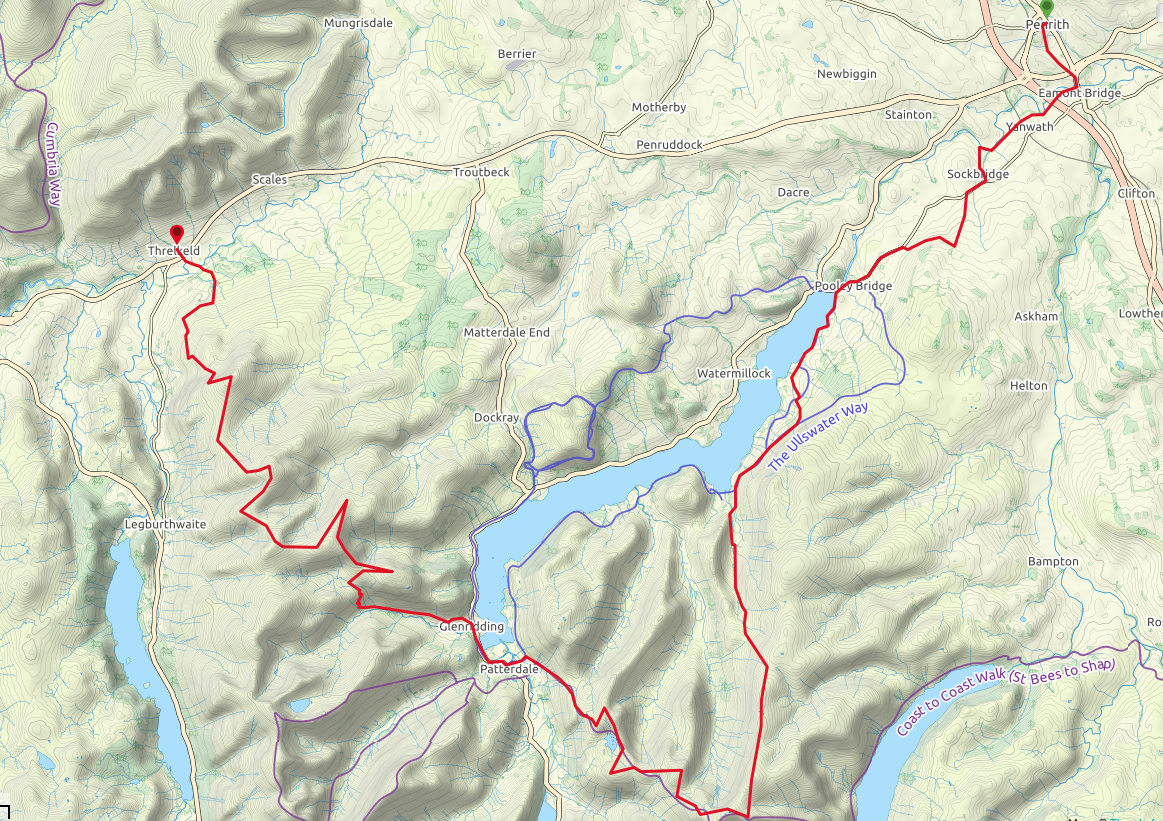
Penrith to Threlkeld, by way of some Elusive Fells

  • Date walked: 24/25th July 2020
  • OS Map: Explorer OL5 – The English Lakes: North-Eastern Area
  • Start/finish point: NY 511 299/NY 322 254
  • Distance: 55km
  • Elevation Gain: 2500m
  • Hills Climbed: High Seat (802m), Kidsty Pike (780m), Rampsgill Head (792m), The Knott (739m), Rest Dodd (696m), Brock Crags (561m), Angletarn Pikes (567m), Sheffield Pike (675m), Hart Side (756m), Stybarrow Dodd (843m), Watson’s Dodd (789m), Great Dodd (857m), Clough Head (726m)

Lakes 1

I’m a fan of coming up with long (perhaps idiosyncratic) walks, joining up hills that I have either missed on previous trips, or would perhaps be a little awkward for me to get to generally. It also makes me feel like I’ve ‘had my money’s worth’ so to speak, given that it takes so long for me to get places on public transport.

And so it was that I set off from Penrith with a plan to walk some of the High Street Roman road (or at least as near to it as you can in the 21st century) and then head off somewhere near High Raise and do a few of the Far Eastern Fells. I strode out of Penrith with a spring in my step, following footpaths through farm fields, the fells teasing me on the horizon. After a while, it became road walking, and I half planned to walk up to Celleron then up on towards ‘The Cockpit’ and on to the fells, some of which I had walked before. In fact, I got to Celleron then suddenly had a change of heart – why not drop down into Pooley Bridge, then walk some of the Ullswater Way? I could always hit the fells somewhere above Howtown.

And so that is how I found myself wandering, one early summer evening, along the path above Ullswater, happy as a pig in muck.

Penrith to Threlkeld

Penrith to Threlkeld

Once past Howtown, I entered Fusedale for the first time – and what a glorious valley! The good path took me gradually along Fusedale Beck and then gradually climbed, and climbed, and climbed, emerging on Wether Hill – hey presto, I was back on the Roman Road. The sun was getting lower in the sky, and up a height the temperature dropped substantially. My mind turned to a bed for the night, but not before bagging Kidsty Pike, Rampsgill Head, and the rather shapely Knott.

Penrith to Threlkeld

Penrith to Threlkeld

Descending The Knott, I found a lovely little flat area overlooking Rest Dodd, and caught sight of several deer. Tent up, perfect spot. Throughout the night the deer came close to the tent and made the most terrifying noises – who’d have thought Bambi would sound like something from a horror film? Very early the next morning I breakfasted in the rain then tackled Rest Dodd head-on, before dropping down towards Brock Crags, along by Angle Tarn, then somewhat awkwardly up to Angletarn Pikes and its list of summits.

As a side note, I was delighted at my previous night’s pitch high up on Knott, and counted no fewer than 17 tents dotted around Angle Tarn. I also counted no fewer than 6 bum cheeks going about their morning movements by the tarn, and found myself feeling a little angry at my fellow man. Or perhaps just bitter that I have braved all manner of uncomfortable conditions in the hills, attending to business far away from my tent, far from paths, digging little holes. At Angletarn-by-the-sea they were only a burger van away from being a resort. Anyway, onwards.

Penrith to Threlkeld

Penrith to Threlkeld

Penrith to Threlkeld

Penrith to Threlkeld

I say onwards, I came across another pair of cheeks at the Boredale Hause ‘junction’, tutted as the cheeks retreated through the tent flaps, then made my way down to Glenridding. Time to adjust myself, attend to aching feet, get rid of rubbish (in a bin, fancy that), before making my way up to the Greenside Road and along the busy path we all know so well.

Penrith to Threlkeld

I stopped to watch the lines of people snake their way up towards Helvellyn, and then left the path to head up to my own private fells, up Stang End and through the interesting remnants of mining works, to make my way to Sheffield Pike. Back down to the path, and then steeply up Glencoyne Head, I was off across to the rather inconveniently situated Hart Side, when the mist suddenly rolled-in and the landscape looked more like it usually does when I’m in the hills.

Penrith to Threlkeld

Penrith to Threlkeld

Penrith to Threlkeld

Next on to the Dodds. The mist cleared every now and then to give me little glimpses of Thirlmere, and by the time I arrived at Watson’s Dodd (an underrated fell in my humble opinion…) the conditions were excellent. I lingered at Watson’s Dodd, and not just because of the name.

Penrith to Threlkeld

Penrith to Threlkeld

The rest of the walk was straightforward, gentle walking – Great Dodd, Calfhow Pike, then straight up the (wet) side of Clough Head. This latter fell has teased me so many times when I’ve travelled by bus into Keswick, it felt great to have conquered it at long last. But it soon conquered me, because the steep descent down the screes made the ending to the walk rather more dramatic and telling on the knees than I would have liked. Great views, though.

And so I snaked my way down to Threlkeld, and had a pint while waiting for my bus, chuffed that I could now tick off a whole bunch of beautiful fells. Fells that have been teasing me for months. Cheers!

Penrith to Threlkeld

Penrith to Threlkeld

Langholm – Round Two (Bivvy Bag Adventures)

  • Date walked: 28th July 2020
  • OS Map: Explorer 323 – Eskdale & Castle O’er Forest
  • Start/finish point: NY 364 865
  • Distance: 20km
  • Elevation Gain: 833m
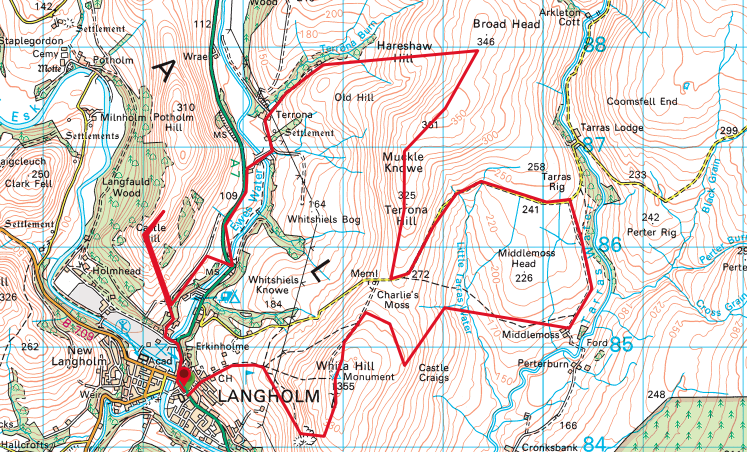
  • Hills Climbed: Whita Hill (355m), Muckle Knowe (361m)

Langholm 2

Langholm is fast becoming one of my favourite spots for walking nearer to home. Here, just a few miles over the border into Scotland, are seemingly endless rolling hills to explore, and the fact I can get here so easily on public transport means it is a wonderful area for overnight escapes. And so, having explored a few hills west of the town a few weeks ago, I headed up one fine July afternoon to take in some hills to the east. I rolled up the bivvy bag and set off on a mini adventure.

It was early evening when I started plodding up the steep track out of Langholm and up to the popular Whita Hill, with its impressive Malcolm Monument. I met a few other people on the path, seemingly locals walking dogs or else going for evening strolls on this modest hill. The views from the top as the sun began to get lower in the sky were excellent.

Langholm

Langholm

Langholm

Leaving the summit of Whita Hill, I followed the path down and around the ‘back’ of the hill, onto a heathery nature reserve. Once past the cairn at Castle Knowe, I struck off into the deep heather and walked roughly in a straight line toward the little ford marked on the OS Map. Some very pleasant (if slightly squelchy) walking followed on the path and over some footbridges to reach the farm track above Middlemoss. Tinnis Hill was looking very attractive in the distance, but perhaps a little too far for a bivvy tonight, so I somewhat aimlessly joined the road at the end of the farm track. I could have continued along to Tarras Water to find somewhere to sleep, but in the end just opted for some heathery slopes under Terrona Hill, unfurled the bag, and settled in for the night.

Langholm

Langholm

Langholm

Though I have frequently been an unlucky camper when it comes to weather, I am yet to have a bad night in a bivvy bag. It was warm but with just enough breeze to keep me comfortable, the heathery mattress was a delight, and the night sky was just something else. Granted, an owl kept swooping at me for the first half hour or so (I suppose I looked like its biggest meal ever, in my bag) but after that it was all meteors, satellites, clear skies, stars that seemed to multiply every time I took a breath and relaxed deeper into the heather. Next morning, I was packed and ready to go in a matter of minutes, then left the road and headed up the boggy ridge to Terrona Hill and Muckle Knowe.

Langholm

I didn’t feel I had time to head on to Hog Fell, so left the path (or at least the fence) somewhere over Hareshaw Hill, and made my way steeply (and roughly) down through a heathery no-man’s land towards Terrona Shiel, then hit the track to Terrona Farm and then followed the A7 towards Langholm – luckily quite quiet at this time of the day. At Highmill Bridge I noticed a footpath not marked on the map, which seemed to offer a way onto Castle Hill, so up I went. Turns out it led to an old track, towards Pathhead. Once there, I decided to climb the steep little climb up to Castle Hill, where I stopped for breakfast and some views back over Langholm. No time to head onto Potholm Hill today, so I dropped gently back down the way I had come, and strolled into Langholm where I donned my face mask and hopped on the bus, and on to Newcastle just about in time to start work.

Langholm